
Nine healing frequencies · Windsor, Melbourne
The Solfeggio Frequencies
Nine tones carried down from Gregorian chant, each one worked with for something specific. Not background music. You choose the one that matches what is actually going on.
- 396 Hz releases fear and the guilt sitting underneath it
- 417 Hz undoes what will not move and clears old trauma
- 528 Hz is the love frequency, and self-love before anything else
- 741 Hz clears what you picked up that was never yours
- 852 Hz cuts through the story you have been telling yourself
About the nine
Six from a hymn, three that complete the set
Six of these tones come from an eleventh century hymn that Gregorian monks chanted with, named after its syllables: Ut, Re, Mi, Fa, Sol, La. That is where do-re-mi comes from. The scale fell out of use for centuries and was rediscovered in the 1970s, and three further tones were identified that complete the pattern.
Sung in harmony those tones were understood to reach below conscious thought, and practitioners still work with them one at a time for exactly that reason. Each has its own job. Pick by what you need, give it fifteen minutes, and notice where it sits in your body.
Choose a frequency
Or pick by what is going on
528Hz
Mi · love and transformation
Underneath real recordings, loaded when you switch one on
All nine play live in your browser, so the pitch is exact and there is nothing to download. Layer water, ocean, rain, wind, birds, crickets or bowls underneath, and set each one where you want it. Play it out loud through a speaker, not headphones - the tone is meant to move through the room and through you.
These are the same frequencies we play live in the studio.
How to listen
Out loud in the room, not through headphones
This matters more than anything else on the page. Headphones put the sound into your ears and stop there. A speaker moves the actual air in the room, and that pressure wave reaches your skin, your bones, the fluid in your body and the field around you. You are not trying to hear the tone. You are trying to be in it.
Put it through a speaker
Phone speaker works. A bluetooth speaker is better. Anything that moves air into the room rather than into your ear canal.
Set it a little away from you
A couple of metres, roughly level with your body. You want the sound arriving at you as a room, not as a point.
Lie down and let it be boring
Eyes closed, nothing to do. Ten to fifteen minutes on one tone is plenty. Longer if you are settled and want to stay.
Notice where it sits
People feel the low tones in the belly and hips and the high ones behind the eyes. If one is uncomfortable, that is information, not a fault. Drop the volume or move to the tone below it.
Why it works this way. Sound is vibration, and you are mostly water. Vibration travels through fluid and fascia far better than it travels through air, which is why a tone played into a room is felt through the whole body rather than just heard. The same principle is what makes a bowl resting on the body so effective in a session. Put a dish of water in front of a speaker and you can watch it happen: the water organises itself into a pattern that belongs to that exact frequency. That is the image at the top of this page.
What to use them for
Start with what is actually going on
Pick by what you need rather than by the number. Tap any frequency below to load it into the player.
Wound up, cannot switch off
Try . Fear and worry sit underneath most of it. Start here, then 174.
Stuck, something needs to move
Try . The undoing tone. Use it when you know what has to change.
Hard on yourself
Try . Self-love before anything else. The one to come back to.
Something unresolved with someone
Try . Relationship repair, including with yourself.
Heavy after a day with people
Try . Clears what you picked up that was never yours.
Overthinking, cannot see straight
Try . Cuts through the story you have been telling yourself.
In physical pain
Try . The body tone. Pair it with 285 and give it time.
Meditating, or want to go deeper
Try . Only really lands if you are already on that path.
When to listen
Short and often beats long and occasional
Ten to fifteen minutes with one tone does more than an hour of cycling through all nine. The body needs time to stop bracing before anything settles, and every time you change the tone you restart that clock.
- First thing — before the phone. 528 or 639 sets a tone for the day rather than reacting to one.
- The 3pm dip — 741 through a speaker while you keep working. You do not have to lie down for this one.
- Walking in the door — the hour where the day is still on you. 741 to clear it, then 396.
- Before bed — 174 or 396, low, from across the room. Leave it running as you fall asleep if you like.
- Before something hard — a conversation you have been avoiding: 639. A decision you keep circling: 852.
If you only do one thing with this page, do this: pick the tone that matches what is going on, play it through a speaker, lie down for fifteen minutes, and do it four days in a row. One long session tells you very little. Four short ones tell you a lot.
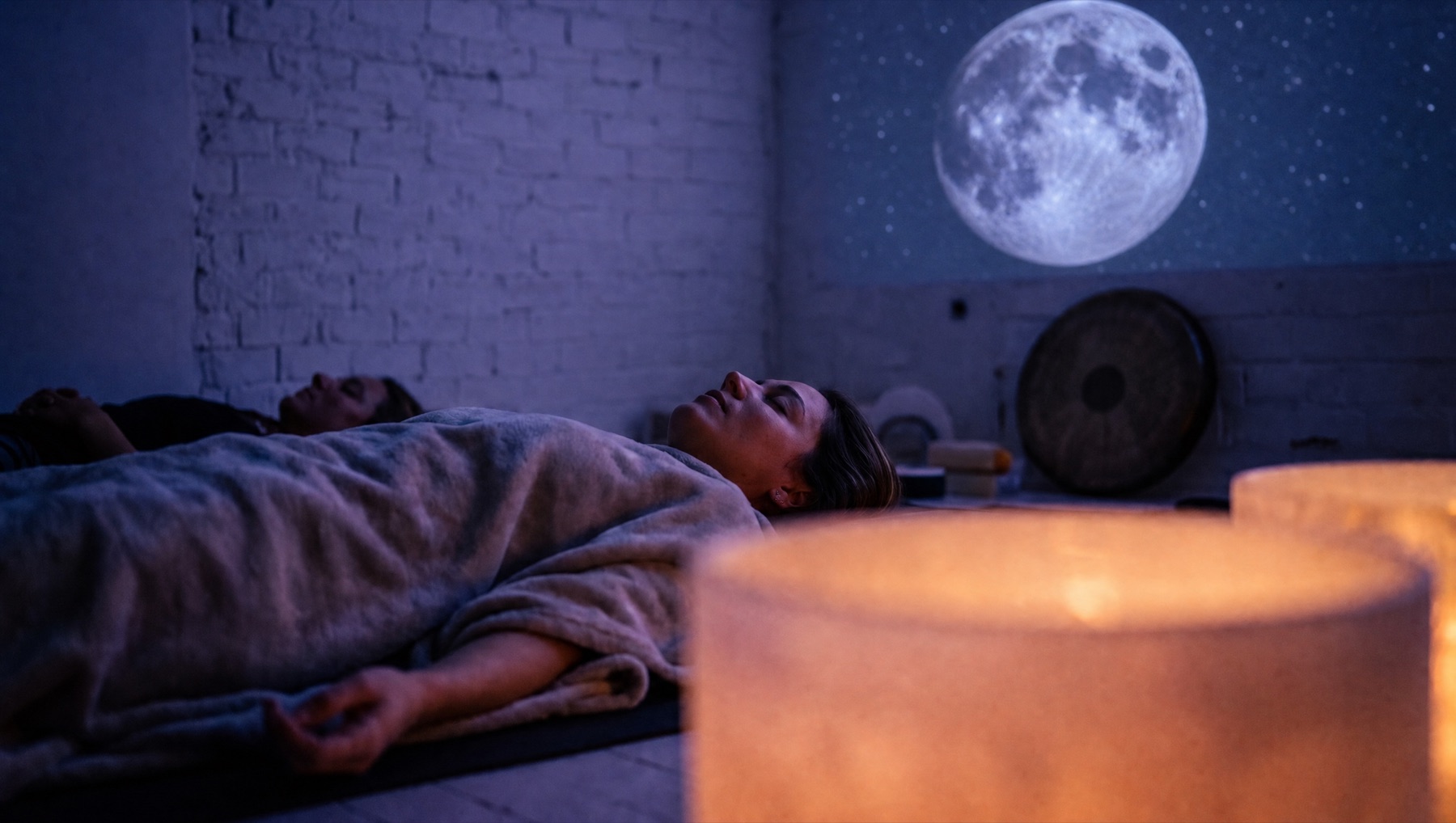
How we work with them
What these tones do in an actual session
Playing a tone from a speaker is the home version. It is genuinely useful, and it is also the smallest version of this work. Here is what the same frequencies do when there is a practitioner in the room.
In a group sound bath
The bowls, gongs and chimes we play are tuned into these frequencies, and they are played live around a room of people lying on the floor. A speaker sends sound at you from one direction. A room full of bowls surrounds you with it, and at that volume you stop hearing it and start feeling it — in the chest, the jaw, the hips. That is the part a phone cannot do.
One to one, reading the field
In a private session Ange reads the energy field first, chakra by chakra, and particular frequencies show themselves as the ones that are asking for attention. Someone carrying old fear tends to bring up 396. Someone mid-upheaval brings up 417. Someone who cannot see past a false story brings up 852. You are not guessing from a list on a website — the field tells you where to go.
Tuning forks, off the body
Then the work is done with tuning forks cut to those exact Solfeggio frequencies. Unweighted forks are used off the body, held steady in the auric field or over the chakra that needs it, with the sides of the fork directing the frequency into the field. Weighted forks go on the body itself for muscle, tissue and bone. That is how a blockage in the field gets cleared rather than just soothed.
Where they come from
A Benedictine monk, a hymn, and six missing notes
The Solfeggio scale was set down by Guido d'Arezzo, a Benedictine monk who lived from around 991 to 1050 and who needed a way to teach monks to sing chant from sight. He took the Hymn to Saint John the Baptist, written by Paulus Diaconus, and used the first syllable of each half-line as the name of a note: Ut, Re, Mi, Fa, Sol, La. That is where do-re-mi comes from, and it is the foundation of Western music notation.
The hymn has a peculiarity that Professor Willi Apel pointed out: each of the first six lines begins one degree higher than the line before it. The music climbs the scale as the words ask to be freed from guilt and to resonate. Ut queant laxis resonare fibris... solve polluti labii reatum — so that your servants may resonate with loosened voices, wash away the guilt of our polluted lips.
These were the tones the Gregorian monks chanted with, and chant sung in harmony was understood to reach deep below conscious thought. Apel argued that the chants in use today are not the originals at all, and that around 152 chants had gone missing from the record. The original six-note scale largely went with them, replaced over the centuries by other tuning systems.
They surfaced again in the 1970s through Dr Joseph Puleo, a naturopathic physician who was led to a repeating pattern of numbers in the Book of Numbers. Reducing the verse numbers with the Pythagorean skein, he arrived at six frequencies that matched the six lost tones. He and Dr Leonard Horowitz published the work in 1999, and that is how the scale reached the modern world. Horowitz called it the Perfect Circle of Sound, for reasons that become obvious the moment you look at the numbers.
The mathematics
Why practitioners call it a perfect circle
Three more tones complete the set — 174, 285 and 963 — giving nine in total, three groups of three. Nine is the number of completion. Written as a grid, the pattern is hard to unsee:
Take any number and move its last digit to the front, and you get the next number in its triad. 396 becomes 639 becomes 963. 174 becomes 417 becomes 741. 285 becomes 528 becomes 852. Every tone in the set, from three starting points.
Stack them in columns and the gap between each pair is always 111. Read across and the gaps are 324 and 243 — the same digits, inverted. Reduce any frequency with the Pythagorean skein and you land on 3, 6 or 9: 396 gives 3+9+6 = 18, and 1+8 = 9. The whole scale sums to 999.
On 111 Hz. The spacing is not an idle number. Professor Paul Devereux, who studies the acoustics of ancient sites, found that Irish burial cairns built of different materials at different sizes all resonate at 111 Hz, as does the Oracle Chamber of the Maltese Hypogeum, cut from rock between 3600 and 2500 BC. MRI work suggests that at 111 Hz the brain steps back from the language centre and shifts toward the right side, which is where intuition and trance live. Pythagoras built his scale from a note at 111 Hz.
The research
What has actually been measured
Dr Alan Watkins, a neuroscience lecturer at Imperial College London, found that Gregorian chant has a measurable effect on the body: monks performing the chants showed the lowest heart rate and blood pressure of their day while singing. Other work has found chant relieves fatigue and lifts mood, and observed that monastic singers need remarkably little sleep.
Dr Glen Rein, a biochemist, ran a study in 1988 exposing vials of DNA to four kinds of music and measuring the change in ultraviolet light absorption. Gregorian and Sanskrit chant produced the largest positive change, between five and nine per cent. Classical music managed about one per cent. Rock music moved it 1.8 per cent in the other direction.
On 528 Hz specifically: a 2018 Japanese study found that five minutes of listening significantly reduced stress markers in the endocrine and autonomic nervous systems, with the researchers concluding it had an especially strong stress-reducing effect even over that short an exposure. 528 nanometres of light is the greenish-yellow at the centre of the rainbow, the colour of chlorophyll, and the colour long given to the heart chakra. NASA's recordings of the sun hover around the same number.
Sound healing supports the body, it does not replace medical care, and nothing here is treatment for a diagnosed condition. If something is wrong, see your doctor as well.
One tone through a speaker is a start. A room full of them is another thing entirely
Crystal and Tibetan bowls, gongs and voice, played live around you while you lie on the floor and do nothing at all. Ninety minutes in Windsor, ten minutes from the Melbourne CBD.
Want the bowls resting directly on the body? That is a one to one session. Questions, text 0489 089 049.

5/1A Windsor Place
Windsor, Melbourne VIC 3181
info@soundofsoma.com.au0489 089 049
Text only. We cannot receive phone calls, so send a message and we will respond as soon as we can.
Use Google Maps, not Apple Maps. Windsor Place is a small lane off Chapel Street, enter via 32 Chapel Street.
Class times change week to week, so check the live timetable before you come.
Sound of Soma acknowledges the Traditional Custodians of Country throughout Australia and their connections to land, sea and community. We pay our respect to their Elders past, present and emerging, and extend that respect to all Aboriginal and Torres Strait Islander peoples today.
Nominated
Healer of the Year
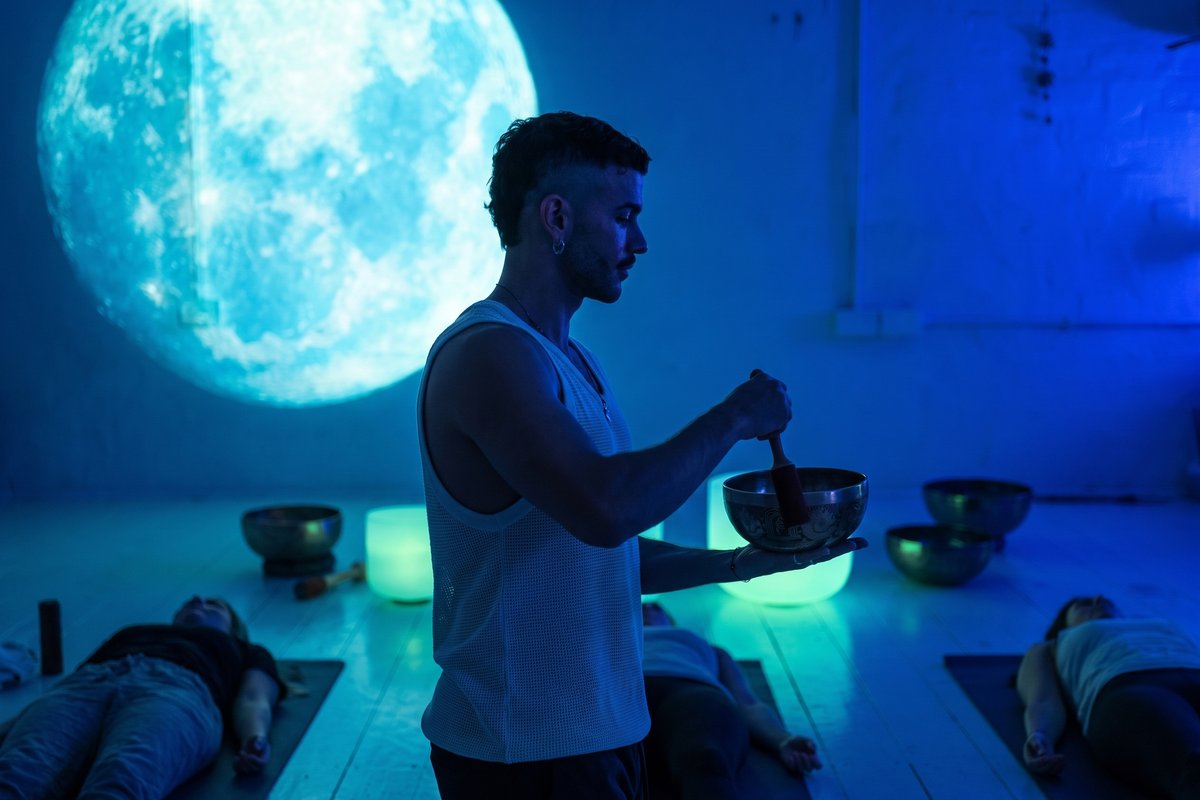
Ange is up for Sound & Energy Healer of the Year 2026, decided entirely by public vote. It’s free, takes ten seconds, and you can vote once a day, every day, until 8 November.
Voting is open now
Vote for Ange Why the daily vote matters