The complete guide
Vibrational sound therapy: what a bowl on your body actually does
What vibrational healing and vibration therapy actually are, how vibration travels through the body, and what it feels like to have a singing bowl resting on you. From our studio in Windsor, Melbourne.
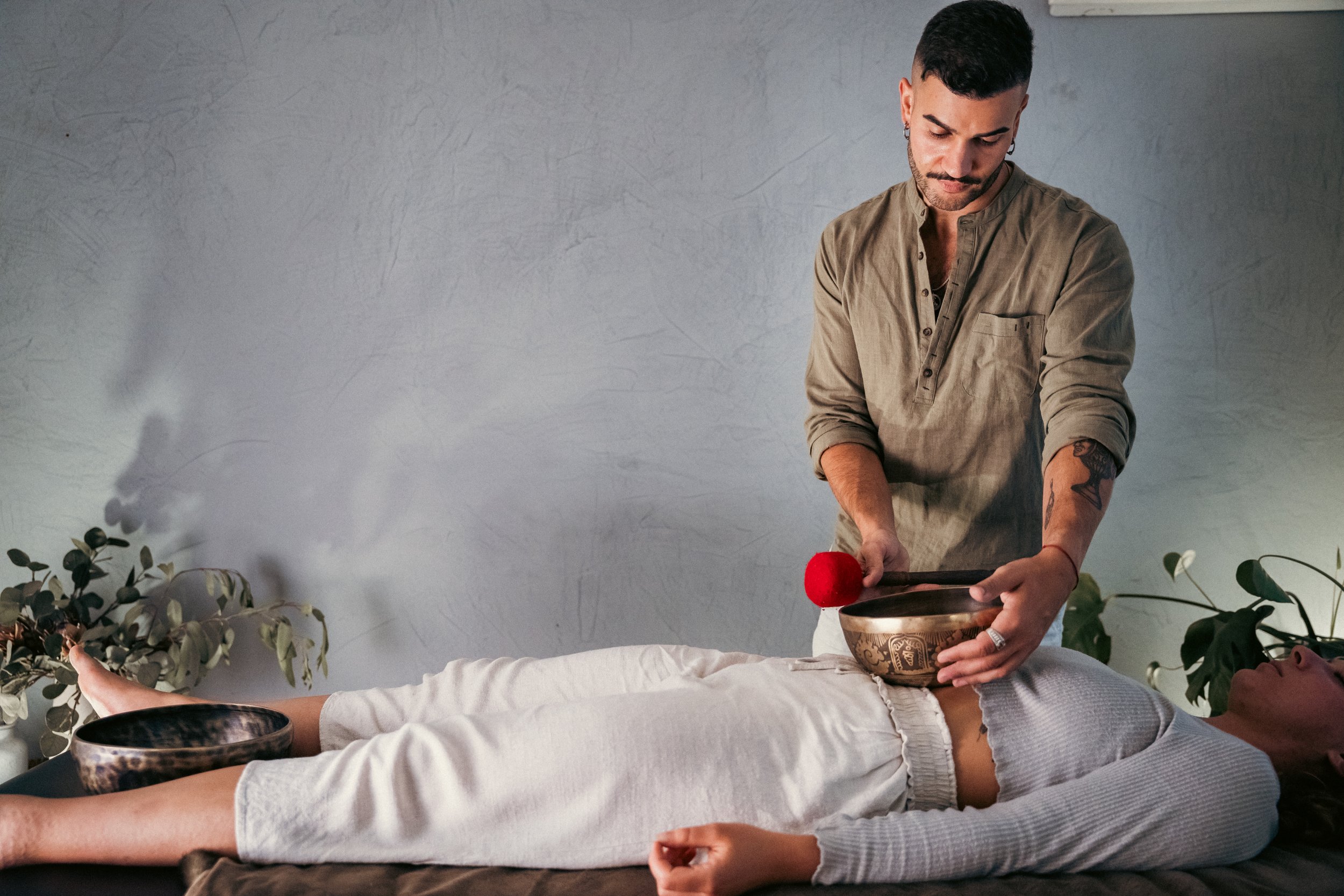
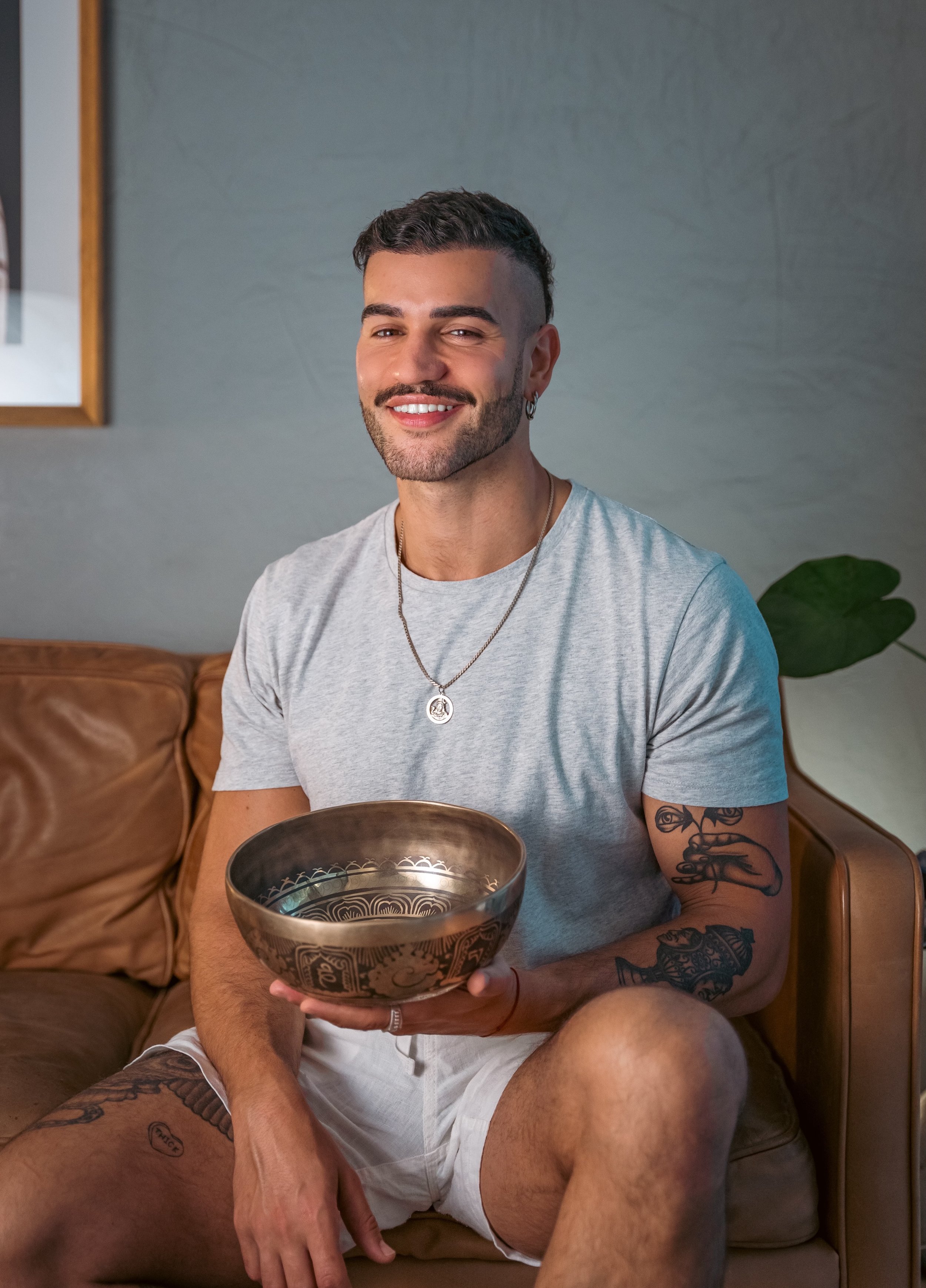 Written by Ange MonittoFounder, Sound of Soma · Windsor, MelbourneAnge healed his own undiagnosed chronic illness through sound after Western medicine ran out of answers. Read his story.
The short answer
What is vibrational healing?
Vibrational healing is a practice where instruments such as crystal and Himalayan singing bowls are used to send mechanical vibration through the body, rather than only sound into the ears. The bowls are played around you and, at points, rested directly on the body. The vibration slows your breathing and heart rate, and moves your nervous system out of fight-or-flight into the state where it repairs.
You will also see it called vibrational sound therapy, vibration therapy, vibrational sound healing or simply sound vibration therapy. They describe the same thing with different emphasis.
The distinction worth holding onto is this. All sound is vibration. What separates vibrational healing from listening to a recording is proximity and contact: the instrument is close enough, or resting on you, that the vibration reaches your tissue rather than just your ears.
The mechanism
How vibration moves through you
Sound is a mechanical pressure wave. It needs something to travel through, which is why there is no sound in space, and it travels very differently depending on what that something is.
You are roughly 70% water, and water carries sound around four times faster than air does. So a bowl played beside you is not simply making a noise near you. It is putting pressure waves into a medium that conducts them extremely well, and that medium is you.
Bone conducts it too. Rest a bowl on the sternum and you feel it through the ribcage and out into the back, because the skeleton carries vibration further than soft tissue alone.
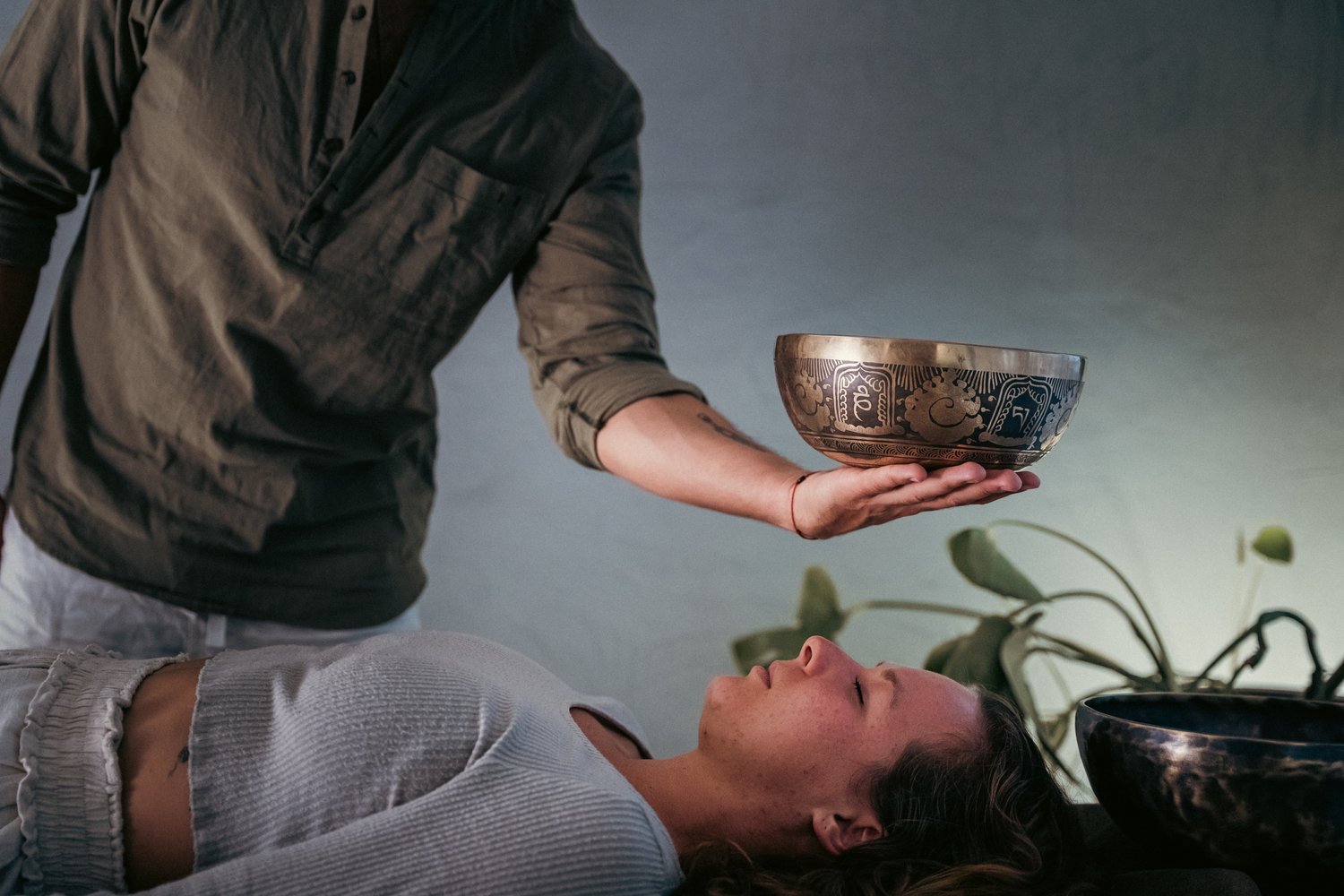
Your ears are not the only way in either. Research published in Nature in 2009 found that we also register the pressure waves of sound through the skin. Hearing is one of the first senses to develop in the womb and one of the last to fade at the end of life.
If you want the full mechanism, including brainwaves and entrainment, it is in our guide to sound healing.
The difference
Hearing it and feeling it are not the same
You can listen to a recording of singing bowls on your phone. It is pleasant, and it will settle you a little. It is also a fundamentally different experience from being in the room.
Through headphones, the vibration reaches your eardrum and stops. In a room with real instruments, especially with one resting on you, it reaches your chest, your belly and your back. People describe it as being inside the sound rather than listening to it.
A recording is heard. A bowl on the body is felt. Those are different events for your nervous system.
Feel the difference for yourself. Classes every day in Windsor, from $40.
Book a vibration massageThe part people miss
You do not need a bowl on you for this to work
Bowls resting on the body are the most dramatic version of it. They are not the only version.
An instrument played two metres away is still putting pressure waves into the room, and you are in the room. Air carries them to your skin, your skin and bone conduct them inward, and the water you are largely made of carries them the rest of the way. The contact version is more concentrated. The ambient version reaches all of you at once.
Three things happen in that hour that have nothing to do with anything touching you.
Your fascia stops gripping
Fascia is the connective tissue wrapping every muscle, organ and nerve, one continuous web from head to foot. Under months of pressure it grips, and that grip is what you feel as a permanently tight neck or a lower back that never quite lets go.
Fascia responds to two things: sustained low-load stretch, and vibration. A sound bath gives you an hour of stillness in which the nervous system stops telling the tissue to brace, with vibration moving through it the whole time. That is why people stand up looser than they lay down, without having stretched.
Your lymph starts moving
This is the one almost nobody explains, and it is worth understanding.
Your lymphatic system has no pump. Your circulatory system has a heart. Your lymphatic system, which carries cellular waste out and immune cells around, has nothing equivalent. It relies entirely on three things: muscle contraction, external pressure, and your breathing.
The diaphragm is the big one. Every deep breath draws lymph upward through the thoracic duct. Shallow chest breathing, which is what stress produces, barely moves it at all. So a person who has been braced and breathing high in the chest for months is, quite literally, not clearing waste well.
An hour of slow diaphragmatic breathing is not just relaxing. It is the main pump your lymphatic system has, finally being used properly.
Why that matters for healing: lymph is how the body removes cellular waste and moves immune cells to where they are needed. When it is sluggish, people describe exactly what you would expect. Puffy. Heavy. Foggy. Catching everything going around. Getting it moving again is unglamorous and it underpins a great deal.
Your own voice adds to it
If you have been in a class where we tone or hum, this is why. Humming produces vibration in the chest and sinuses and it requires long slow exhales, so it drives both the vibration and the breath at once.
Researchers in Sweden found that humming triggers a substantial release of nitric oxide in the nasal cavity. Nitric oxide widens blood vessels, which increases blood flow and lowers blood pressure, and it supports immune and respiratory function. Separate studies at Nepal Medical College and the National Institute of Mental Health and Neurosciences in India found that five minutes of humming measurably reduced stress.
Five minutes. In the car. For free. It is the most underrated thing in this entire practice.
One honest caveat on all of this. The mechanisms above are well established physiology: lymph has no pump, the diaphragm drives it, fascia responds to vibration, humming produces nitric oxide. What is not established is any claim that sound flushes toxins or cures conditions. We are not going to tell you that, because it is not true.
What people come for
The benefits of vibrational therapy
- Held physical tension Vibration reaches muscle and fascia directly. People report shoulders, jaw and lower back letting go in a way that listening alone does not produce.
- Sleep The most reported effect. Low, sustained vibration moves you toward the rest state, and the sleep that night is usually the deepest in weeks.
- Stress and burnout An hour of vibration is read by the body as a safety signal, shifting you out of fight-or-flight into the state where repair happens.
- An overactive mind You are not asked to concentrate. The vibration gives your nervous system something external to follow, which is why it works on people who cannot meditate.
- Feeling disconnected from your body This is the one people do not expect. Vibration puts sensation back into places that had gone quiet.
- Emotional heaviness Feelings you have been too busy to feel often surface. That is not a side effect of vibrational healing, it is much of the point.
Vibrational healing is not a treatment for medical conditions and we do not present it as one. What it reliably does is change the state your nervous system is running in, and a great deal follows from that.
Watch it
What bowls on the body actually look like
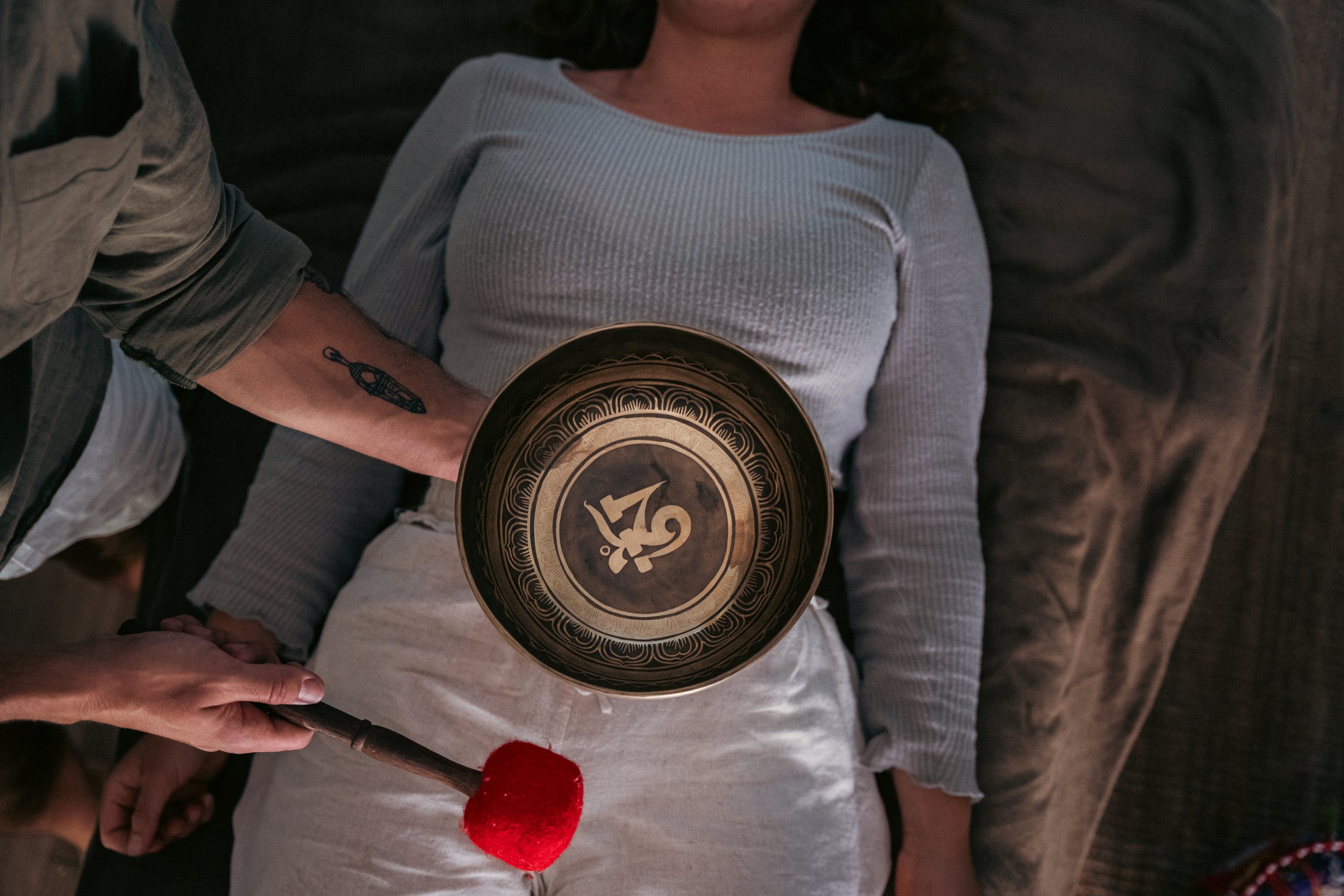
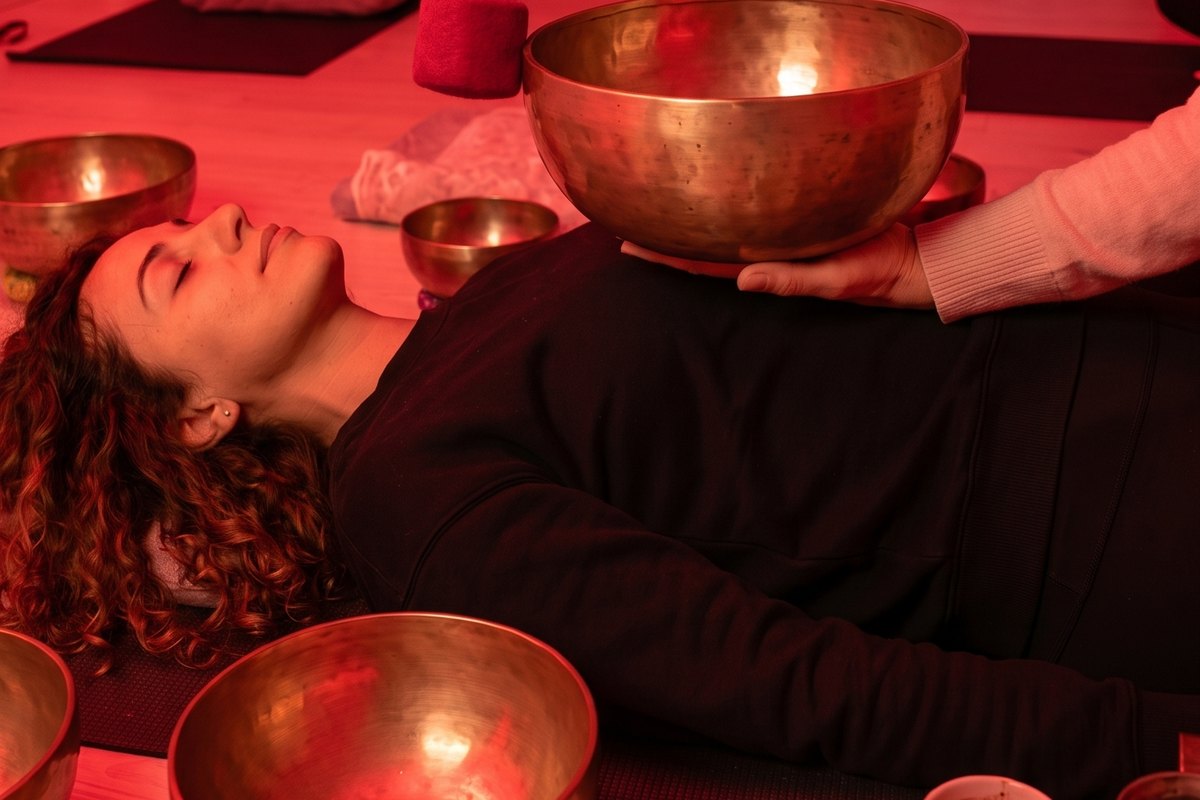
This is the part that is hard to picture until you see it. The bowl is placed on the chest, the belly or the back, struck softly, and left to ring out while the vibration travels through you.
The class built around it
Yin and Sound: vibration massage in a group class
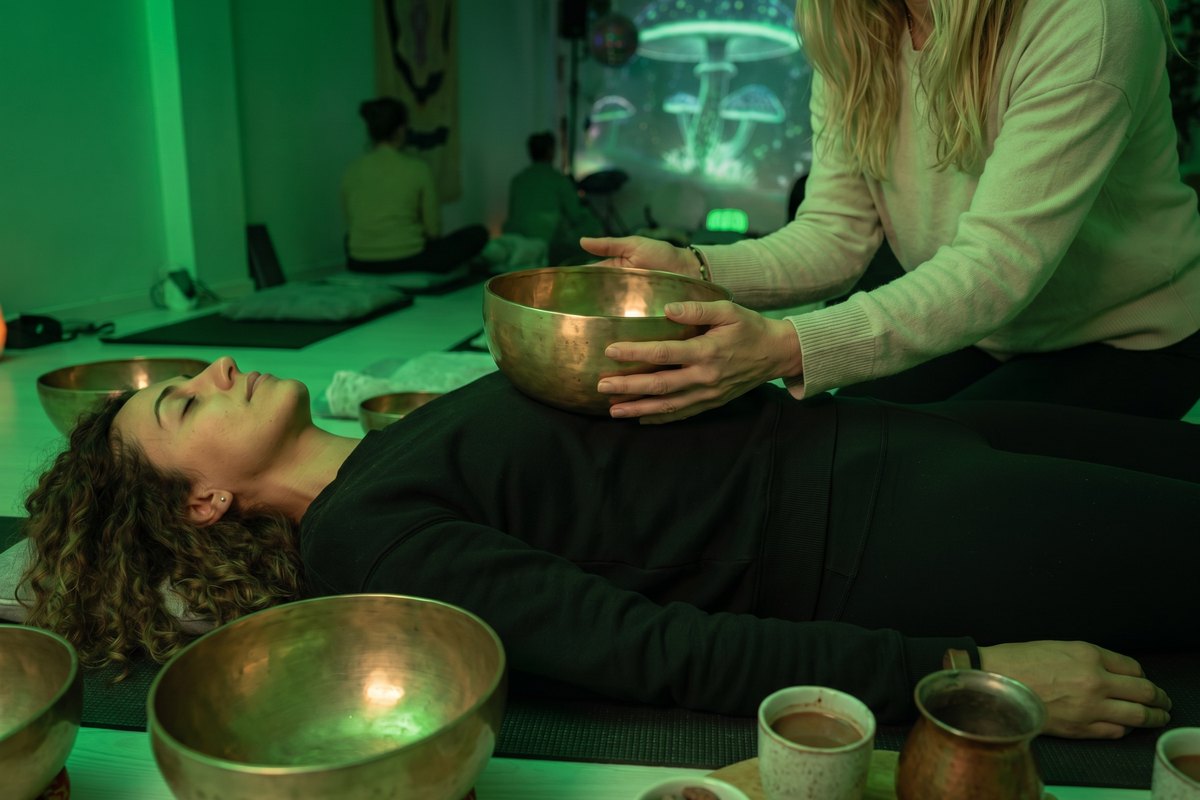
If the 1:1 is the concentrated version, this is the accessible one. Slow, supported yin yoga while Charlie works Tibetan bowls around the room and rests them directly on the body, where the vibration releases tension straight from the tissue.
The pairing is the point. Yin holds each shape for several minutes with full support, so gravity does the stretching and the fascia has time to soften. That is precisely when vibration gets furthest in. Long holds open the tissue, the bowls go into it.
What actually happens
- You settle in. Warm low light, bolsters, blankets. Charlie opens with a few minutes of breath, enough to arrive, nothing that feels like work.
- Shapes held long and soft. Floor-based yin poses, each held for a few minutes with plenty of support. Gravity does the stretching.
- The bowls come to you. Played around the room and, at times, rested on the body.
- A sound-held rest to finish. You leave lighter, calmer, and sleeping deeper.
Three classes, each leaning a different way
- Grounding · Mondays 7pm · 60 min · $40 Lower body. Works into the hips, lower back and inner thighs, the areas that hold most and let go last. Bowls rest over the belly and sacrum. For feeling settled and steady again.
- Heart Opening · Wednesdays 6:30pm · 60 min · $40 Upper body. Slow supported shapes for the shoulders, chest, jaw and neck, with bowls resting on the chest and shoulders. For the shoulders that carry everything.
- Letting Go · Sundays 10am · 90 min · $59 Opens with a cup of ceremonial cacao, then long-held shapes for the chest, belly and hips, with time to journal. For what you are ready to put down.
No experience needed and you do not need to be flexible. Mats, bolsters, blankets and eye pillows are provided. Weekly at 5/1A Windsor Place, Windsor.
Grounding, Heart Opening or Letting Go. From $40, everything provided.
Book a vibration massageOne to one
The Vibration Healing session
A group class is the same soundscape for everybody in the room. This is the bowls-on-the-body session, one to one, built entirely around you: bowls placed where your body is actually holding, and as long as it takes on any one area.
Everything is provided: mat, bolster, blanket and eye covering. No preparation, and nothing is asked of you during the session. It can be combined with frequency healing, Reiki or fascia work in the same appointment.
Rated 4.9 on Google by our Windsor community.
Book vibrational healingYour first time
What to expect
- You stay fully clothed. Wear something warm and comfortable. Your body temperature drops as you settle.
- You lie down and do nothing. Mats, bolsters, blankets and eye pillows are provided.
- You are asked before anything is placed on you. If you would rather nothing touched you, say so. Nobody has to explain themselves.
- The vibration builds slowly. Most people lose track of time. Some fall asleep. Both work.
- You come back gently. We leave time at the end rather than turning the lights straight on.
Some people feel tired or tender the next day, especially after a first session. That is normal, and we have written honestly about it in sound bath negative effects.
Where to try it
Vibrational healing in Melbourne
If you have been searching for vibrational healing Melbourne, vibrational sound therapy near you, or a vibration therapy session in Melbourne, this is what we do. Sound of Soma is a dedicated studio at 5/1A Windsor Place, Windsor, minutes from Chapel Street and a short walk from Windsor Station.
Two ways in:
- Yin and Sound Group classes with bowls resting on the body. From $40, weeknights, no experience needed.
- Vibration Healing, one to one The bowls-on-the-body session, built around you. $250 in studio.
We are one of the few dedicated sound and vibrational healing studios in Melbourne rather than a room hired by the hour.
Everything people ask
Vibrational healing FAQs
What is vibrational healing?
Vibrational healing, also called vibrational sound therapy or vibration therapy, uses instruments such as crystal and Himalayan singing bowls to send mechanical vibration through the body rather than only into the ears. Bowls are played around you and, at points, rested directly on the body. The vibration slows breathing and heart rate and moves the nervous system toward its rest state.
What is the difference between sound healing and vibrational healing?
They overlap almost completely. Sound healing is the broader name; vibrational healing emphasises the part you feel rather than hear. In practice, any session where instruments are rested on or close to the body is vibrational healing.
Can you actually feel the vibration?
Yes, and it surprises most people. With a bowl resting on the chest or belly you feel it in the ribcage and through the back. It is the single most common thing first-timers mention afterwards.
Is vibrational sound therapy scientifically supported?
The mechanism is well established: sound is a mechanical pressure wave, tissue conducts it, and slow steady low frequency shifts the autonomic nervous system toward rest. The clinical literature on outcomes is young and mostly small. We would rather tell you that than overclaim.
Do the bowls go on your body?
In our Yin and Sound classes and in 1:1 sessions, yes, with your consent and only where you are comfortable. In a standard group sound bath the bowls are played around the room rather than on individual people.
Is it safe?
For almost everyone. Speak to your doctor first if you are pregnant, particularly in the first or third trimester, live with epilepsy, have a pacemaker or another implanted device, or are recovering from recent surgery. Tell us either way and we will adjust.
How much is a 1:1 vibrational healing session in Melbourne?
The one-to-one Vibration Healing session, where bowls are placed directly on the body, is $250 in studio with Ange or Jack. Group Yin and Sound classes, where bowls also rest on the body, start from $40.
How often should I have vibrational therapy?
One session is genuinely worth doing. Weekly is where people notice things change, because the system stops storing up so much between sessions.
You have to feel it
Reading about vibration only gets you so far
The difference between hearing a bowl and having one resting on your chest is not something an article can hand you. Come and find out which one you have been missing.
Ange

5/1A Windsor Place
Windsor, Melbourne VIC 3181
info@soundofsoma.com.au0489 089 049
Text only. We cannot receive phone calls, so send a message and we will respond as soon as we can.
Use Google Maps, not Apple Maps. Windsor Place is a small lane off Chapel Street, enter via 32 Chapel Street.
Class times change week to week, so check the live timetable before you come.
Sound of Soma acknowledges the Traditional Custodians of Country throughout Australia and their connections to land, sea and community. We pay our respect to their Elders past, present and emerging, and extend that respect to all Aboriginal and Torres Strait Islander peoples today.
Nominated
Healer of the Year
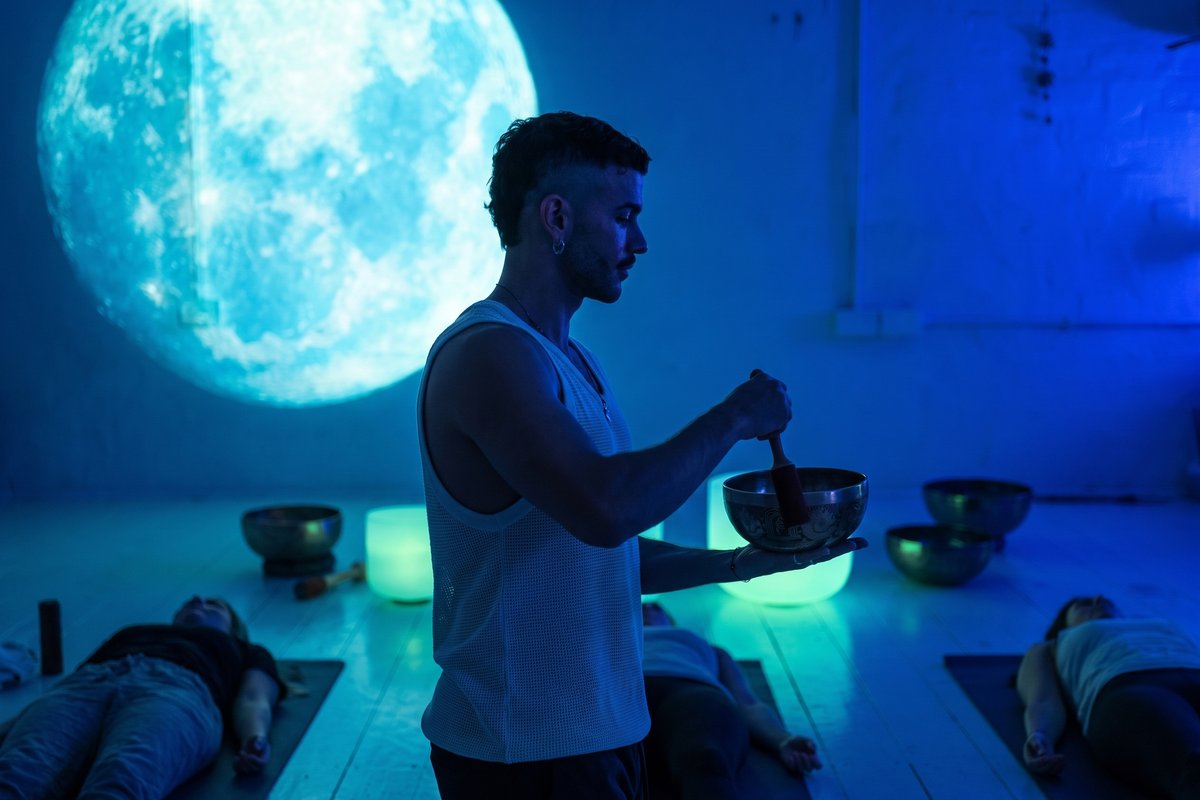
Ange is up for Sound & Energy Healer of the Year 2026, decided entirely by public vote. It’s free, takes ten seconds, and you can vote once a day, every day, until 8 November.
Voting is open now
Vote for Ange Why the daily vote matters