The journal · Sound of Soma
Full moon, new moon and your nervous system
What the research really says about the moon and your sleep, where the old moon rituals come from, the astrology and frequency of the lunar cycle, and why we time our sound baths to it.
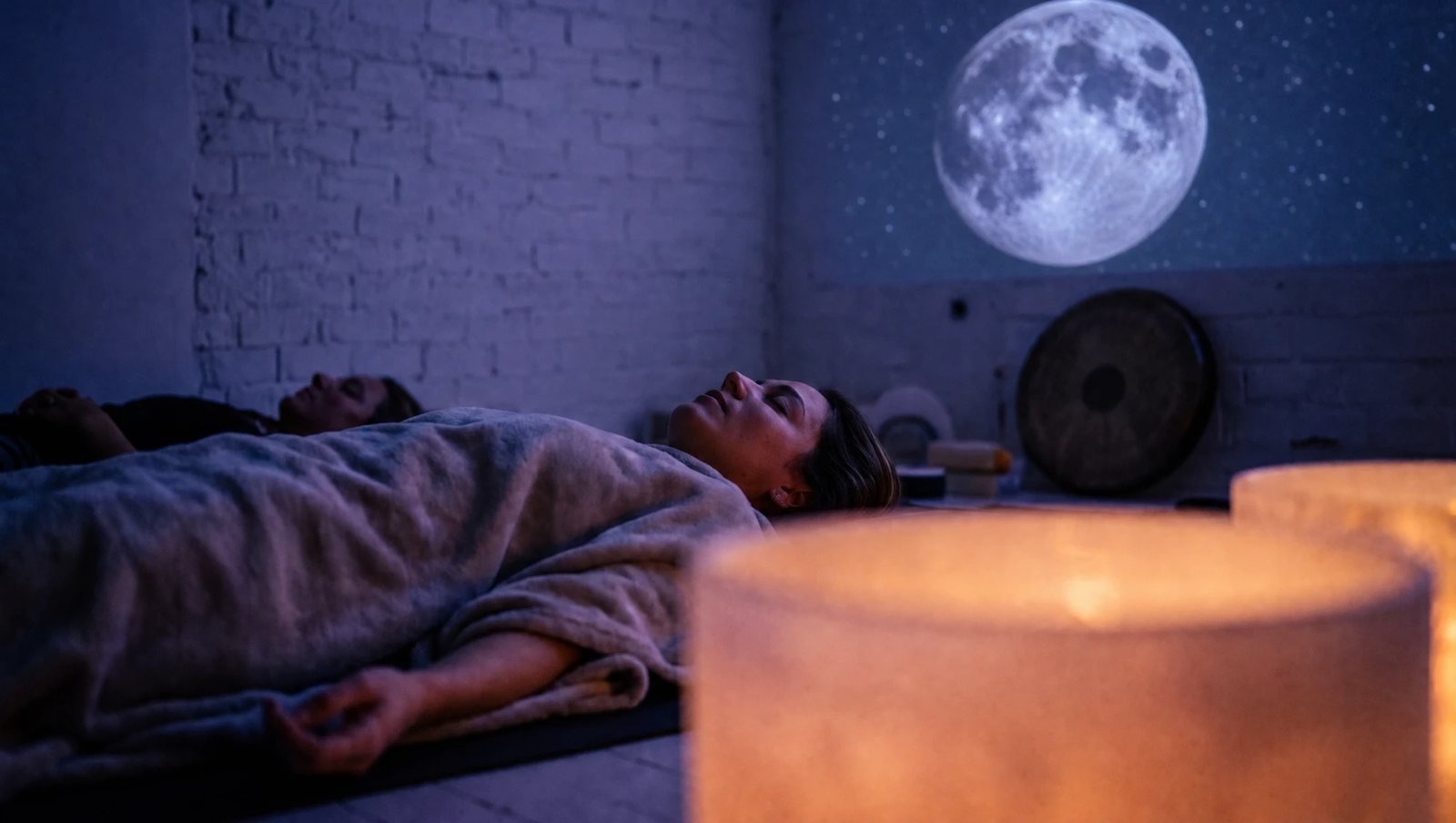
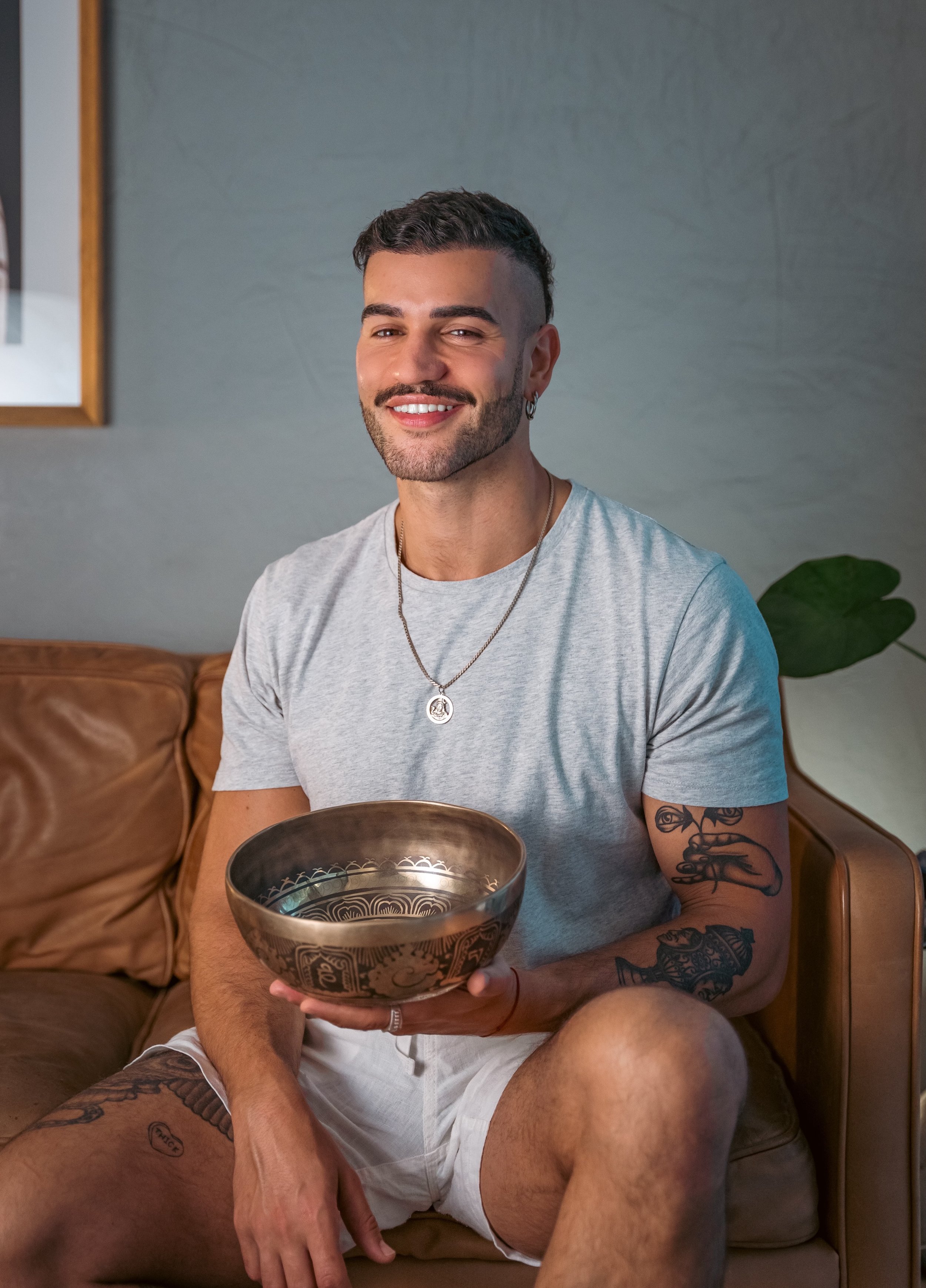 Written by Ange MonittoFounder, Sound of Soma · Windsor, MelbourneAnge healed his own undiagnosed chronic illness through sound after Western medicine ran out of answers. Read his story.
I have noticed it in the studio for years. The week of a full moon the room fills faster, people arrive more wired, and more of them tell me afterwards that they have not been sleeping. The week of a new moon feels different again, quieter and heavier, as though everyone came in already half asleep.
For a long time I kept that to myself, because it sounds like exactly what a sound healer would say. Then I went looking at the research, and it turns out scientists have been arguing about the same thing for years, with sleep labs, wrist monitors and decades of data. Some of what they found surprised me, and some of it did not hold up. Here is all of it: the science, the origins, the spiritual side, and what we actually do with it.
Right now
Where the moon is for you right now
This works itself out live from wherever you are reading, in your own time zone. It shows the phase tonight, how much of the moon is lit, and when the next full and new moon land.
The moon, right now
Loading the moon
Worked out live for where you are
The full and new moon each come round every 29.5 days.
The next six months of full and new moons
Times shown in your own time zone.
One full cycle, from new moon to new moon, takes 29.53 days on average. Come back to this page any time and you will know exactly where in it you are.
The astronomy
What a full moon and a new moon actually are
The moon makes no light of its own. What we see is sunlight bouncing off it, and the phases are simply how much of that lit half is turned towards us as the moon travels around the Earth.
At the new moon, the moon sits between the Earth and the sun. Its lit side faces away from us, so the sky is at its darkest, and the moon rises and sets with the sun and hides in its glare.
At the full moon, the Earth sits between the two. The whole lit face turns towards us, the moon rises at sunset, and it stays up all night.
That loop, new to full to new again, is called the synodic month. It is the oldest clock human beings have, and as you will see further down, the word month itself comes from it.
The tides
The moon moves the oceans
The moon's gravity pulls on the whole planet, but it pulls a little harder on the side of the Earth facing it than on the far side. That difference stretches the oceans into two bulges, one under the moon and one on the opposite side, and as the Earth turns through them we get two high tides and two low tides roughly every day.
The sun does the same thing at a little under half the strength. Twice a month the two line up, at the new moon and at the full moon, and their pulls add together. Those are the spring tides, when high tides run highest and low tides run lowest. The name has nothing to do with the season. It comes from the water springing up.
At the half moons the sun and moon pull at right angles and partly cancel each other out, which gives the gentler neap tides. So the full moon and the new moon are both the strongest points of the month, which is part of why so many traditions honour both of them and not just the bright one.
One is bright and one is dark, and both of them move the whole ocean.
What about the water in your body?
You will often hear that the body is around 60 per cent water, so if the moon moves the ocean it must move us too. I want to be straight with you about this one. The tide works because an ocean is thousands of kilometres across, so one side of it is measurably closer to the moon than the other. Across a body less than two metres long the difference is far too small to move anything, which is why a glass of water on your bench has no tide.
So if the moon affects us, and the research below suggests it can, gravity pulling on our fluids is probably not how. Light is a far better candidate, and so is rhythm itself: every living thing on this planet evolved under a moon that brightens and darkens on a 29.5 day loop. Corals on the Great Barrier Reef spawn on it. Some fish and crabs time their breeding to it. It would be strange if we were the one species that kept nothing of it.
The research
What the science says about sleep
In 2013 a team at the University of Basel went back through sleep data they had collected in a tightly controlled lab, with no windows, no clocks and no view of the sky. Around the full moon, the brain activity linked to deep sleep dropped by around 30 per cent. People took about five minutes longer to fall asleep, slept about 20 minutes less, said they had slept worse, and had lower levels of melatonin, the hormone that tells your body it is night.
In 2021 a University of Washington team took the question out of the lab. They put wrist monitors on people in Toba/Qom communities in northern Argentina, some living with no electricity at all, and on university students in Seattle. In every group, sleep moved with the moon. In the three to five nights leading up to a full moon, people went to bed later and slept less. The effect was strongest where there was no electric light, but it was still there in the middle of a city.
The same year, researchers working through up to 32 years of women's menstrual diaries found that many cycles fell intermittently into step with the moon, most clearly when the moon was at its closest to Earth, and that the link faded with more artificial light at night.
The honest part
Not every study agrees. When a group in Munich checked more than a thousand people across thousands of recorded nights in 2014, they could not find the effect at all, and they pointed out that studies which find nothing tend to stay in the drawer. The fair summary is that the moon's effect on sleep is real for some people, some of the time, and modest. If you are one of the people who sleeps lightly around the full moon, you are not imagining it. If you sleep straight through, that is normal too.
Your body
Your nervous system at the full and new moon
Sleep is where your nervous system does its repair. When the deep, slow part of the night gets shorter, you wake with less in the tank, and a system already running on stress feels it first. That is the pattern I see most in the studio around the full moon: people who were coping start to feel wired, reactive and a bit raw, without knowing why.
A few things are probably stacking up at once. More light at night nudges melatonin down. A shorter night leaves the body less time on the rest-and-repair side of the nervous system. And if you already run hot, with a busy mind at bedtime, those few nights before the full moon can be enough to tip you over.
The new moon tends to sit at the other end of the swing. The nights are at their darkest, and a lot of people describe feeling flat, tired, inward or low on energy. There is no need to push through that. In almost every tradition that tracks the moon, the new moon is a time for rest, stillness and starting again quietly.
The full moon is the time to let something go. The new moon is the time to rest before you begin.
The origins
We have been watching the moon for 40,000 years
One of the oldest possible calendars we know of is a small piece of baboon bone found in the Lebombo Mountains between South Africa and Eswatini, dated to more than 40,000 years ago and cut with 29 notches. Many researchers read it as a count of the days in a lunar cycle. In France, a bone from Abri Blanchard around 30,000 years old carries a winding line of marks that appears to track the moon through two months.
Here in Australia, First Nations astronomy is among the oldest continuous knowledge of the sky anywhere on Earth. The Yolngu people of Arnhem Land noticed long ago that the highest tides come with the full and new moon, and explained it through the moon, Ngalindi, filling with water as he rose out of the sea and emptying as he waned. The explanation is different to the physics, but the observation is exactly right, and it came from watching carefully for a very long time.
The moon is written into our language too. The words month and moon share the same old root. So does lunatic, from the Latin luna, which says a lot about how seriously people once took the full moon's effect on the mind.
And it runs through spiritual practice all over the world. In Buddhism the full and new moon are Uposatha days, set aside for renewed practice, meditation and reflection, and the Buddha's birth, awakening and passing are all remembered on a full moon. In Hinduism, Purnima, the full moon, is kept with fasting and devotion, and Amavasya, the new moon, is a day for honouring the ancestors. The Chinese, Islamic and Jewish calendars still run on the moon today.
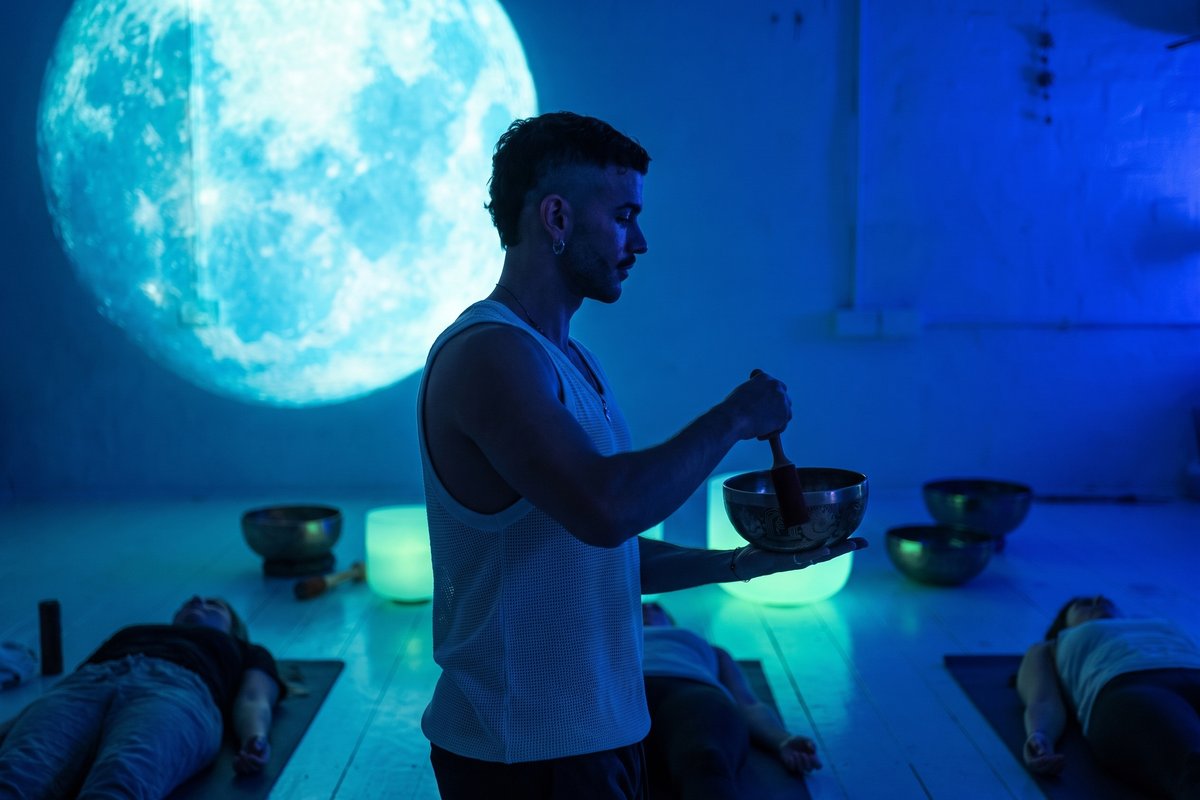
When we hold a moon sound bath in Windsor, we are doing something people have done in one form or another for as long as there have been people.
Astrology
The astrology of full and new moons
You do not need to believe in astrology to find it useful. I think of it as a very old language for the same cycle we have been talking about, one that gives each part of the month a meaning you can work with.
At the new moon, the sun and moon sit together in the same sign of the zodiac. Astrologically this is the seed point of the month, the moment a new cycle begins. It is traditionally the time to set intentions and plant something new, and to start quietly. Nothing is visible yet, and that is the point.
At the full moon, the sun and moon sit directly opposite each other, in opposite signs. It is the moment of most light and most tension, when what was started at the new moon reaches its peak and whatever has been hidden gets lit up. Traditionally it is a time for completion, gratitude and release: noticing what has come to fruition, and letting go of what you do not want to carry into the next cycle.
The moon also moves into a new sign roughly every two and a half days, which is why you will hear about a full moon in Aries or a new moon in Libra. Each one carries its own flavour, and if you enjoy working with that, it adds another layer to the practice. If you do not, the simple rhythm of beginning at the new moon and releasing at the full moon works perfectly well on its own.
Energy and frequency
The moon as a frequency
Everything that repeats has a frequency. A heartbeat does, a breath does, and so does the moon. It is just very slow, at one cycle every 29.53 days.
In the 1970s a Swiss mathematician and musicologist, Hans Cousto, showed that you can turn any cycle like this into a sound by doubling its frequency, octave after octave, until it rises into the range we can hear. Doubling keeps it the same note, only higher, in the same way a low C and a high C are the same note. Done with the synodic month, it lands at 210.42 Hz, a G sharp.
That is the note behind the planetary tuned instruments you will find in some studios, including the Synodic Moon tuning forks and gongs made to Cousto's calculations. In sound healing it is traditionally linked with the sacral centre, and with emotion, fluidity and connection, which fits a planet that moves water.
I want to be clear about what that is. No study shows that 210.42 Hz does something to your body that another tone cannot. What it gives you is a way of bringing the rhythm of the moon into the room as sound, so the cycle you are marking and the note you are hearing are the same thing. The part that is well supported is the bigger picture: steady, rhythmic, low sound gives a busy nervous system something to settle into, and the body follows. That is the science of a sound bath, and it works at every phase of the moon.
Sound healing
Why sound healing matters at the full and new moon
If the moon is going to unsettle your sleep and your nervous system a few nights a month, those are the nights to give your body the most support.
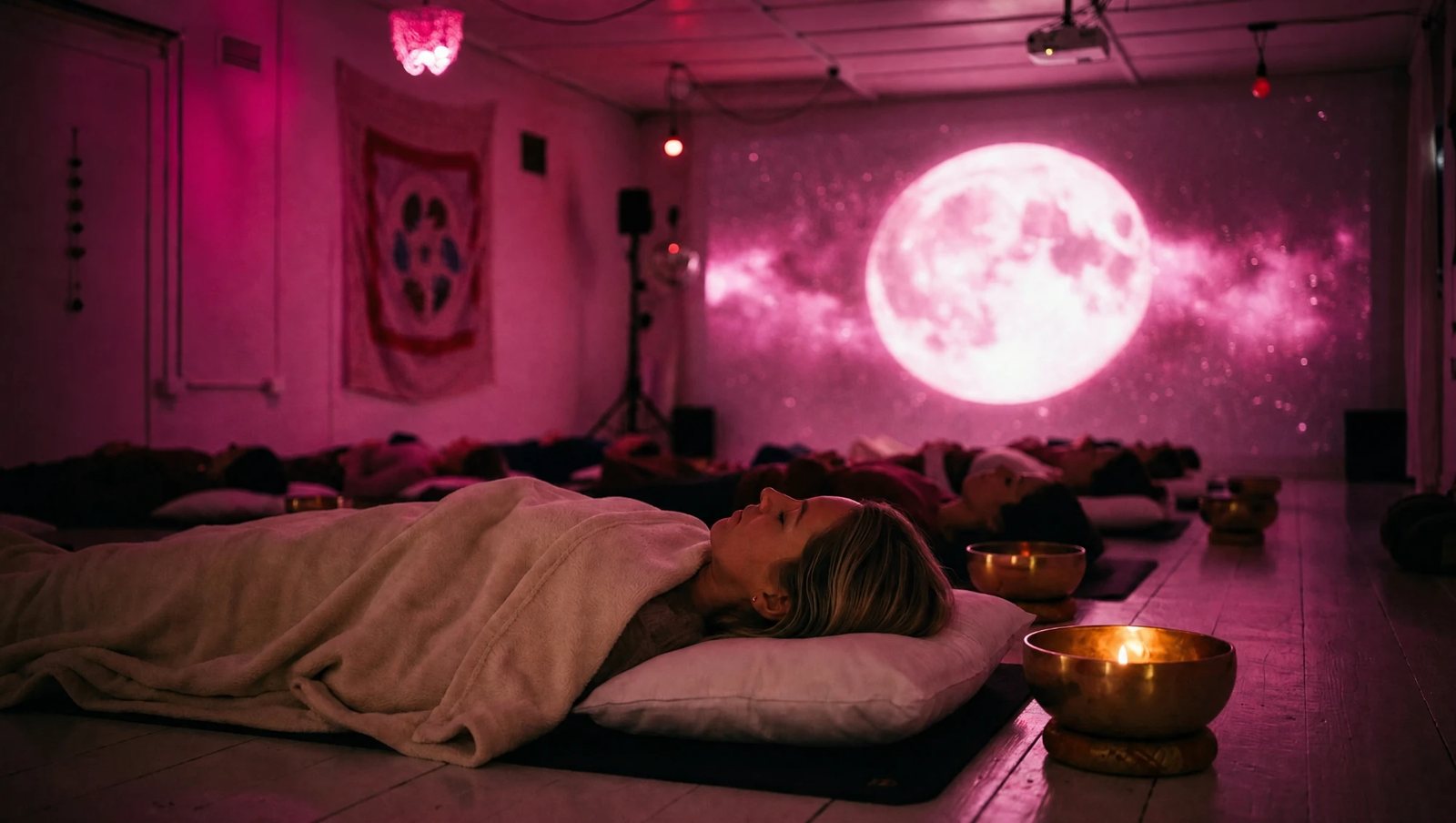
At the full moon, most people are running a little hotter. Sleep is lighter, the mind is busier, and emotions sit closer to the surface. A sound bath does the job your nervous system is struggling to do by itself that week, which is to come down. An hour of sustained, low, rhythmic sound moves you out of fight-or-flight and into rest-and-repair, and many people sleep better that night than they have all week. It is also the natural point in the cycle to let something go, and it is far easier to release lying down with your breath slowing than sitting at a desk with your jaw clenched.
At the new moon, energy runs lower and the pull is inward. A sound bath here is less about bringing you down and more about letting you rest completely, somewhere dark and warm, with nothing asked of you. It is the quiet reset before the next cycle, and the best state to set an intention from, because you are choosing it from a settled place.
Then there is the part that has nothing to do with astronomy. A room full of people choosing to stop together, on the same night, under the same moon, is a powerful thing. People have gathered on the full moon for tens of thousands of years, and there is a reason it still feels good.
Practical
What to do at a full moon
- Protect the three nights before. This is where the research sees the biggest shift. Screens off an hour earlier, the room properly dark, nothing big first thing the next morning.
- Go outside and look at it. Ten minutes under a full moon, barefoot on grass if you can, is one of the simplest ways to come down after a day indoors.
- Write a release list. What has come to its peak this month, what you are grateful for, and one thing you are ready to stop carrying. Then close the book.
- Move before you try to be still. If you feel wired, shake it out or walk for a few minutes before you lie down. Charge in the body needs somewhere to go.
- Keep the evening gentle. Less caffeine and alcohol, a warm shower or bath, and an earlier night than you think you need.
- Come to a full moon sound bath. Ninety minutes lying down, with the whole room coming down together.
Practical
What to do at a new moon
- Rest without guilt. Low energy at the new moon is common. Take the early night and cancel what does not need doing.
- Set one intention. Just one, written down, for the cycle ahead. Small and specific works better than big and vague.
- Make the room dark. The new moon brings the darkest nights of the month, which makes them good nights for your best sleep. Blackout, phone out of the room, wifi off.
- Keep it quiet. A short sit, some slow breathing, a long bath. Let the week be a little emptier than usual.
- Start something small. The new moon is for beginnings, so begin the habit now rather than waiting for a perfect Monday.
- Lie down in a new moon sound bath. The deepest rest of the month, and the calmest place to start again from.
Our moon sound baths run every month in Windsor. The next full moon is coming up soon.
Book a moon sound bathSources
Where this comes from
Everything above that is presented as research comes from the studies below. The spiritual and astrological parts are traditions, offered as traditions.
- Cajochen and colleagues (2013). Evidence that the lunar cycle influences human sleep. Current Biology.
- Casiraghi and colleagues (2021). Moonstruck sleep: synchronisation of human sleep with the moon cycle under field conditions. Science Advances.
- Helfrich-Förster and colleagues (2021). Women temporarily synchronise their menstrual cycles with the luminance and gravimetric cycles of the Moon. Science Advances.
- Cordi and colleagues (2014). Lunar cycle effects on sleep and the file drawer problem. Current Biology.
- NOAA National Ocean Service. What are spring and neap tides?
- Hamacher and Norris. Australian Aboriginal astronomy: an overview.
- Australian Indigenous Astronomy. The Moon.
- Encyclopaedia Britannica. Uposatha.
- Moon phase times on this page are calculated live using Jean Meeus, Astronomical Algorithms, and checked against timeanddate.com.
Under the next full moon
Come and lie down under the moon
Whatever you make of the astrology, the moon is a good excuse to do something your nervous system has probably been asking for: stop, lie down, and let the sound do the work for an hour.
We run full moon and new moon sound baths every month from our studio at 5/1A Windsor Place, Windsor, alongside sound healing, yin and fascia classes every day of the week.
Ange

5/1A Windsor Place
Windsor, Melbourne VIC 3181
info@soundofsoma.com.au0489 089 049
Text only. We cannot receive phone calls, so send a message and we will respond as soon as we can.
Use Google Maps, not Apple Maps. Windsor Place is a small lane off Chapel Street, enter via 32 Chapel Street.
Class times change week to week, so check the live timetable before you come.
Sound of Soma acknowledges the Traditional Custodians of Country throughout Australia and their connections to land, sea and community. We pay our respect to their Elders past, present and emerging, and extend that respect to all Aboriginal and Torres Strait Islander peoples today.
A half-day retreat
Spring Energy Cleanse
4 October sold out·New date added
Sunday 11 October2pm to 5.30pm
Cacao, a palo santo cleanse, yin, Tibetan bowls resting on the body and a sound bath. Three and a half hours to put down what you do not want to carry into the new season.
See the afternoon