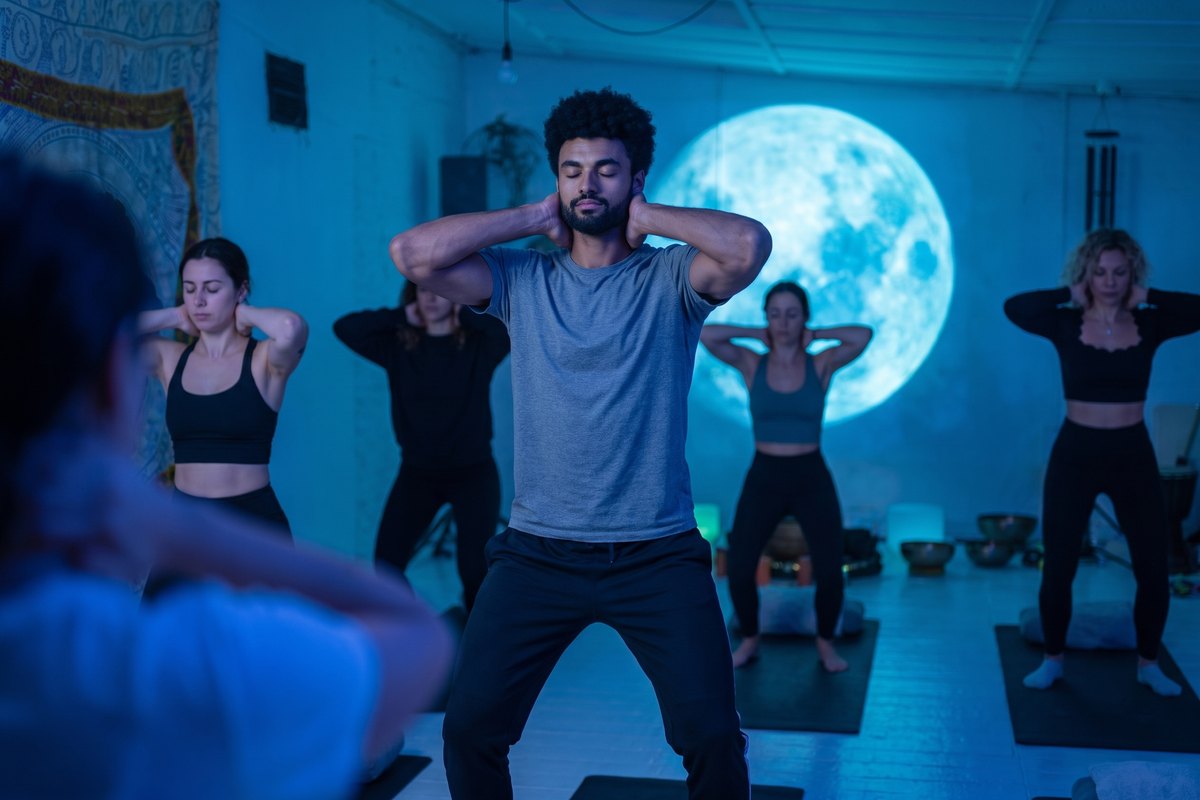
7 ways to regulate your nervous system and heal with sound and frequency
What nervous system regulation actually means, and the seven practices — some at the studio, most free at home — that carried me out of chronic illness and now shape everything we teach in Windsor.
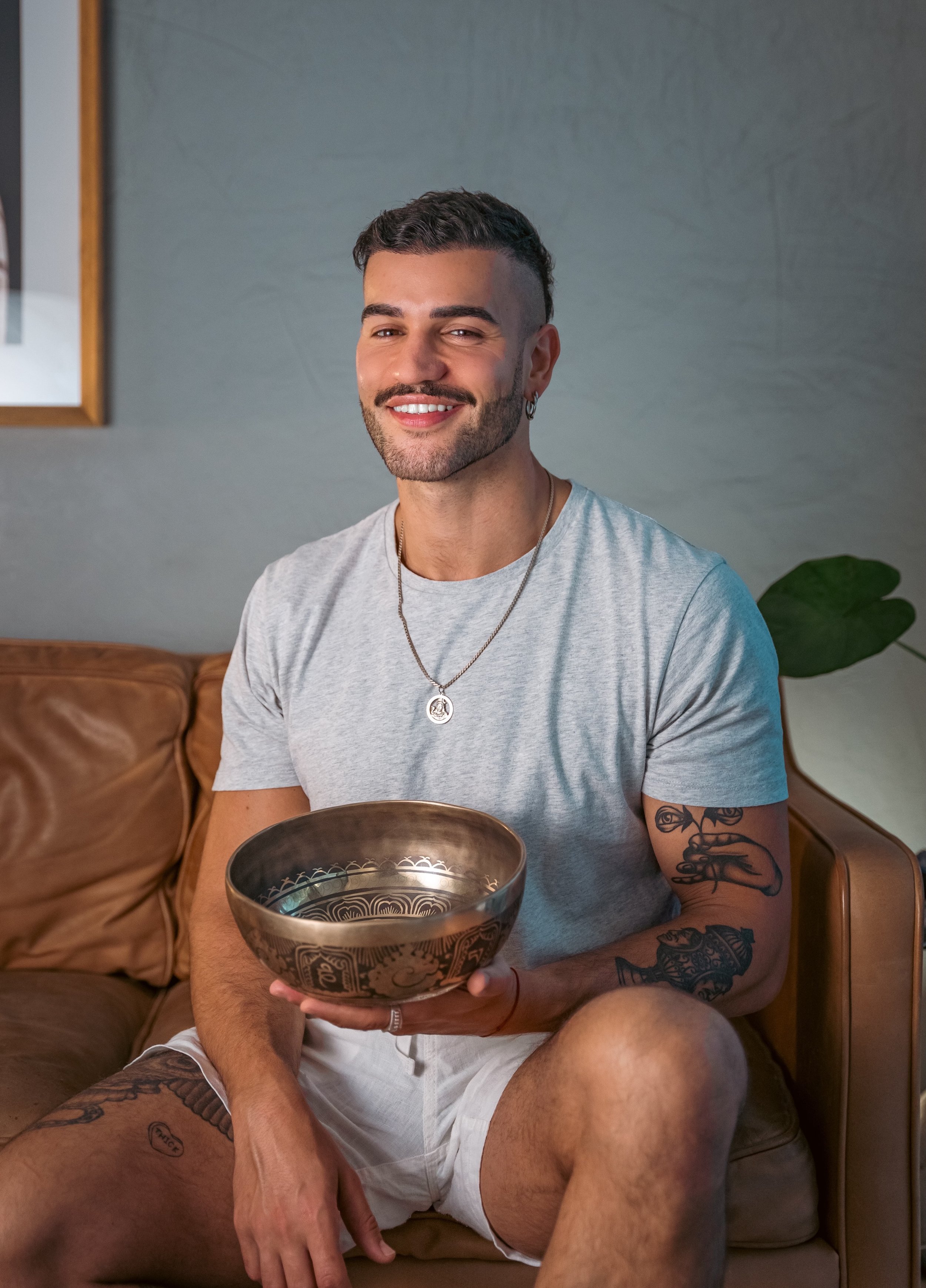
Written by Ange MonittoFounder, Sound of Soma · Windsor, MelbourneAnge healed his own undiagnosed chronic illness through sound after Western medicine ran out of answers. Read his story.
Where this comes from
I wrote this from experience
In 2021 I was sick with an illness no doctor could name. I was sleeping sixteen hours a night and waking up exhausted. I collapsed in Bali at 28, flew home with no answers, and spent months watching the tests come back clean while I got worse.
What finally moved the needle was not another referral. It was my first sound bath, in March 2022. Over the next eighteen months I rebuilt my health from the inside out, and the thread through everything that worked was this: my nervous system had been stuck in survival mode for years, and sound gave it a way back to safety.
I went on to train formally — a Diploma of Sound Therapy through the Australian College of Sound Therapy in the Kyela Sound Therapy Method, and the Solfeggio Energy Centres training with Think and Grow Education — and opened Sound of Soma. This is the guide I wish someone had handed me when I was sick.
First, the science
What regulating your nervous system actually means
Your autonomic nervous system runs everything you never think about: heartbeat, breathing, digestion, immunity. It has two main modes. The sympathetic branch is the accelerator — fight-or-flight. The parasympathetic branch is the brake — rest, digest, repair.
When your brain perceives danger, your adrenals release adrenaline and cortisol. Heart rate climbs, muscles brace, digestion and immune housekeeping go on hold (StatPearls: the stress reaction). Brilliant for escaping real danger. Designed to switch off when the danger passes.
The problem: the brain responds to real stress and imagined stress the same way. Deadlines, doomscrolling, old grief — the body reads it all as threat, and a system built for minutes runs for years. Chronic stress is now understood as a major contributing factor in inflammation, poor sleep, gut trouble, anxiety and slowed healing. A dysregulated nervous system feels like being wired and tired at once.
Regulation is the practised skill of returning to the brake. Researchers call that return the relaxation response: slower heart rate, deeper breath, muscles releasing, repair back online. And here is the line from my training that changed how I spent my evenings:
Passive relaxing does not produce the relaxation response. The couch rests your legs, not your nervous system.
The relaxation response comes from active practice, and sound is the most effortless doorway to it that I know. Two principles do most of the work. Resonance — every structure responds to the frequencies it naturally vibrates at. Entrainment — when two rhythms meet, the steadier one gradually pulls the other into sync, the way you cannot help walking in time to a drum. Your brain is a rhythm-keeping organ, and its activity moves through five bands:
Gamma39 to 42 HzHeightened perception and peak focus.
Beta13 to 38 HzAlert, thinking, concentrating. Your normal waking mind, and where you get stuck.
Alpha8 to 12 HzDeeply relaxed, or just about to fall asleep.
Theta4 to 7 HzDreamy and meditative. The twilight between sleep and waking.
Delta1 to 3 HzDeep, dreamless sleep.
Harmonic sound nudges the brain out of busy beta into alpha and theta — parasympathetic territory, where music and sound have been shown to lower cortisol and calm the stress response (Thoma et al., 2013). The full mechanism, from entrainment to why you sleep so well that night, is in the science of a sound bath. New to all of it? Start with what is sound healing.
Way one
Sound baths: let the instruments do the meditating
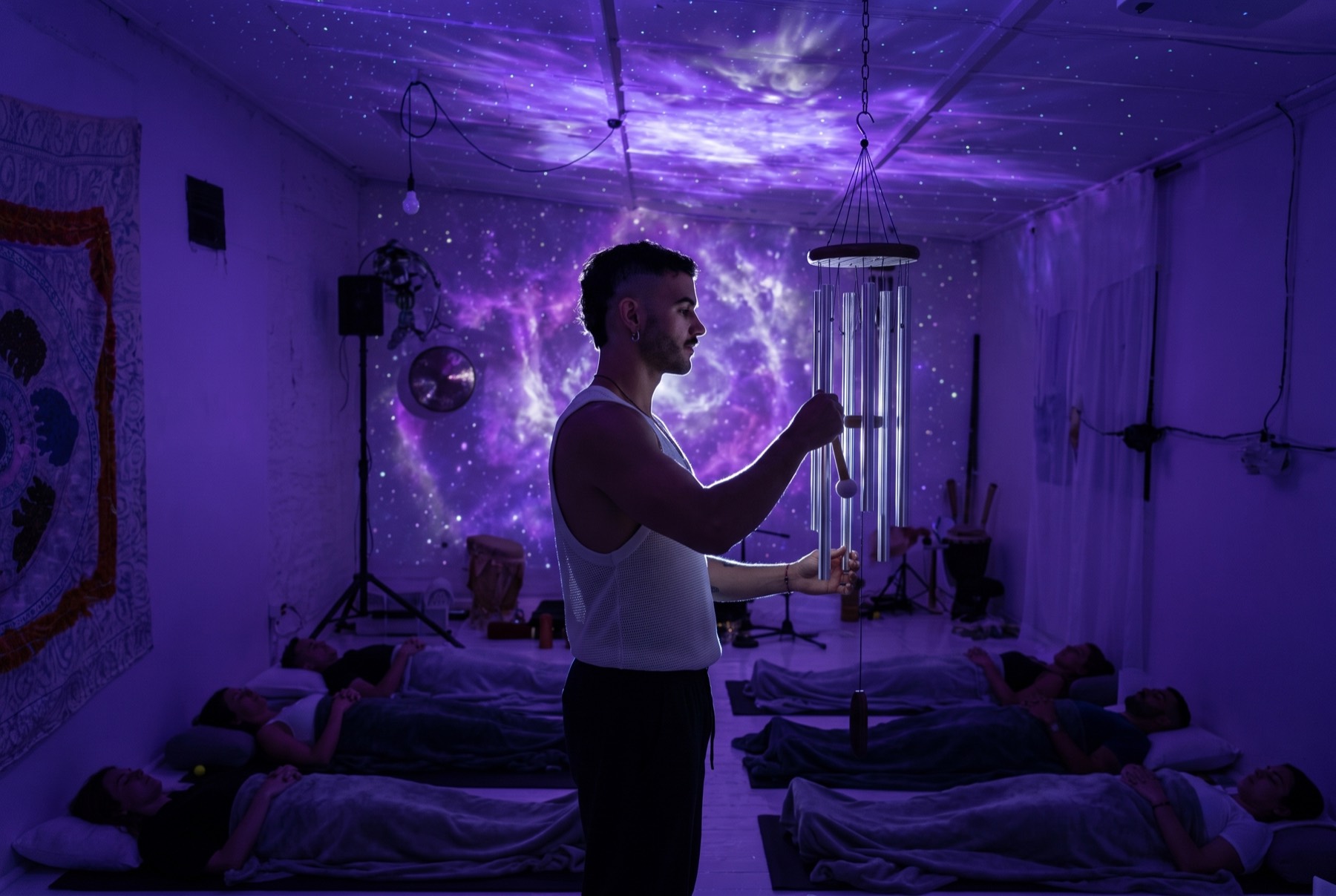
The easiest entry point, because it asks nothing of you. You lie down, covered and warm, while gongs, crystal and Himalayan bowls, chimes and drums are played around you — sound you feel through the body as much as hear. If silent meditation has never worked for you, this is the shortcut: a harmonically played soundscape settles the brain into alpha and theta automatically. No technique required.
In a published study of singing bowl sound meditation, participants showed significant drops in tension, anxiety, low mood and fatigue after a single session — first-timers most of all (Goldsby et al., 2017).
The studio in session. The body does not need to be taught how to entrain. It remembers.
When I was at my sickest, one weekly sound bath was the only practice I could actually keep. That consistency mattered more than intensity: the nervous system learns safety through repetition, the same way it learned stress.
Weekly sound baths run at our Windsor studio, from $49. Everything provided.
Solfeggio frequencies are a set of specific tones used in contemplative music for centuries and repopularised over recent decades. In the Solfeggio Energy Centres tradition I trained in, each tone is matched to one of the body’s energy centres — the chakras — and the emotional territory that centre governs. Western science has not verified claims like DNA repair, so hold the frame lightly: what these tones reliably give you is a focused, resonant anchor for ten minutes of genuinely active relaxation. And that, the research does support.
174 Hz—Traditionally used for easing pain and stress.
285 Hz—Physical restoration and repair.
396 HzRootReleasing guilt, shame and fear. Grounding, stability, security.
417 HzSacralSupporting change. Creativity and pleasure.
639 HzHeartReconnection, forgiveness, trust in relationships.
741 HzThroatHonest expression. Finding your words.
852 HzThird eyeIntuition and the bigger picture.
963 HzCrownOneness and connection. The highest state.
How to practise it:
Choose by what you are working with, not what sounds nicest. The tracks that challenge you are often doing the most.
Earphones, quiet room, sitting upright, eyes closed, volume comfortable. Two minutes of slow breathing first opens the door.
Ten minutes, morning and evening. Morning sets your day. Evening unwinds it.
Keep a one-line journal — before, during, after. Review it every week or two. Small changes are the evidence your critical brain needs.
Do not be discouraged if you feel nothing at first. In my own healing the shifts arrived over weeks, not sessions, and showed up first as better sleep and a longer fuse.
Way three
Slow breathing: the remote control you were born with
Your breath is the one lever of the autonomic nervous system you can grab at will. Short, high chest breathing signals danger. Slow, low belly breathing signals safety — and slow breathing around five to six breaths a minute is consistently linked with higher heart rate variability, the classic marker of a resilient nervous system. Three techniques from my training. Pick one:
4-7-8 breath, for anxiety spikes. Tongue resting behind your top front teeth. In through the nose for 4, hold for 7, out through the mouth with a soft whoosh for 8. Four cycles — under a minute. Mild light-headedness means it is working. Many people find it can settle rising panic on the spot.
Belly breathing, for every day. One hand on chest, one on stomach. Breathe in through the nose so only the bottom hand rises, exhale slowly through pursed lips. Six rounds. This is the foundation everything else builds on.
Alternate nostril, for a racing mind. Close the right nostril with your thumb, inhale left. Close the left, exhale right. Inhale right, swap, exhale left. Two to three minutes.
These cost nothing, take minutes, and are exactly what we hand people to take home after class. The practice between the practice.
Way four
Grounding: borrow the Earth’s steadiness
Grounding — earthing — is direct contact between your body and the earth. Bare feet on grass, sand, soil. The research is early but interesting: reviews report effects on sleep, pain and stress markers (Chevalier et al., 2012). From my own recovery I can tell you something simpler: ten barefoot minutes outside reliably ended the spaced-out, buzzing, not-quite-here feeling of my worst days.
You know you are ungrounded when you feel dizzy, scattered, off balance or anxious for no reason you can name. A quick test from my training: stand on one leg. If you wobble instantly, come back to earth. A three-breath practice:
Feet flat, deep breath in. On the exhale, let your attention drop from your head into your belly and legs.
Next exhale, send it down. Imagine the breath travelling down your spine and off your tailbone into the ground, like a grounding wire. Feel gravity through your feet.
Third exhale, let go. Send down anything that is not yours to carry today — thoughts, worries, other people’s moods — and let the earth neutralise it.
Do it barefoot on grass and you have combined the physiology and the practice in one.
Way five
Vibration on the body: when sound becomes touch
Everything above works through the ears. This one works through the tissue. Your body is roughly 70 percent water, and water conducts sound beautifully — which is why a Tibetan bowl placed directly on the body sends its vibration deep into muscle and fascia, the connective web that wraps every structure in you and grips under long-term stress.
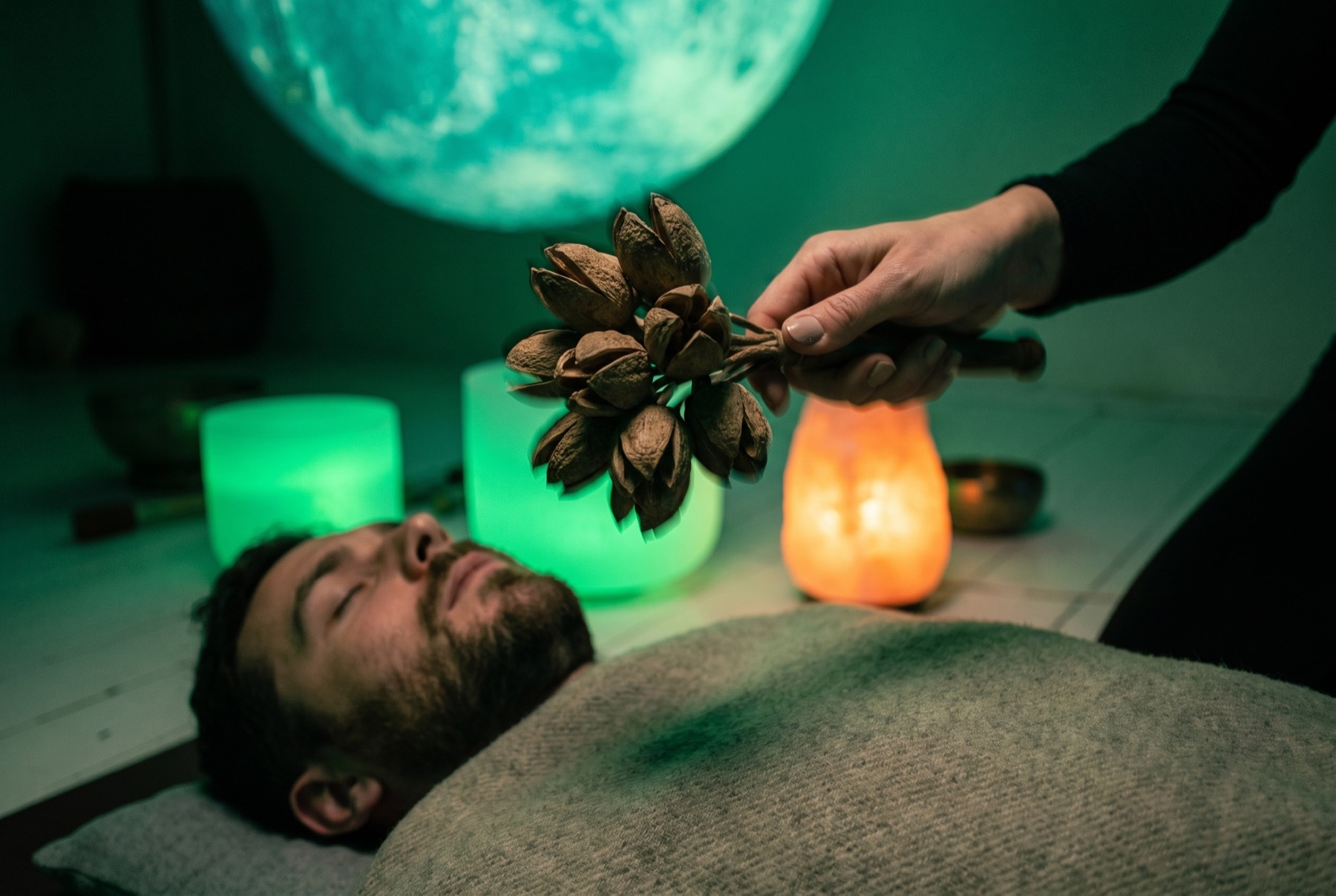
Vibration meets stillness in a 1:1 session at the studio.
People carrying years of tension often feel this modality faster than anything else: the vibration meets the body exactly where the stress settled. It pairs naturally with fascia release — if your shoulders live up around your ears, read how to release tight shoulders — and it is the heart of our Yin + Sound classes, Fascia + Sound, and deeper 1:1 vibration therapy sessions.
Way six
Humming and toning: your voice is the first instrument
You own the most powerful sound tool there is. When you hum or tone a long vowel, the vibration is generated inside your own body — chest, throat, skull — and the slow exhale it rides on is itself a parasympathetic signal. Brain imaging of chanted “OM” shows deactivation in the brain’s emotional alarm centres, consistent with a calming, vagus-mediated effect (Kalyani et al., 2011). Finding your own tone:
Sit comfortably, lips softly together, and hum on a long exhale.
Slide the pitch up and down until you find the note that feels effortless — the one that seems to hum you. That is your fundamental tone.
Stay on it for five to ten slow breaths, feeling where it vibrates: chest, face, skull.
Finish with one minute of silence. Notice the stillness it leaves behind.
Toning is what I hand to people who say they cannot meditate. You cannot ruminate and hum at the same time — the sound occupies the exact channel the worry wants to use.
Way seven
A sound sleep protocol: regulate overnight
Sleep is when the parasympathetic system does its deepest repair, and it is the first thing a dysregulated nervous system loses. Rebuilding mine was the single biggest lever in my recovery. Three layers, strongest evidence first:
Protect your melatonin. The hormone of darkness is suppressed by bright and blue light. Screens off, or at least dim, for the last hour. Bedroom dark and cool. Non-negotiable.
Give the brain a descending rhythm. Binaural beats play a slightly different tone into each ear; the brain perceives the difference as a slow internal beat and tends to follow it down. A meta-analysis found measurable effects on anxiety, though results vary person to person (Garcia-Argibay et al., 2019). Choose a delta-range track as you fall asleep, or simply play any slow harmonic soundscape softly in the room. Run it as a one-week experiment and let your mornings judge.
My own ritual: the phone goes to airplane mode. WiFi off, phone silent, every night. I will be straight with you about the mechanism — the strongest science here is about notifications, light and the twitch to check, not electromagnetic fields. But the effect is real either way. A phone that cannot ping you is a nervous system that is not on call. My sleep improved noticeably the week I started.
The fastest way to change the signal your body is sending is to change the emotion you are practising. Your heart’s rhythm becomes measurably smoother during genuinely felt positive emotion — researchers at the HeartMath Institute call it coherence — and that ordered rhythm feeds calm back to the brain. One minute, adapted from their work: rest a hand on the centre of your chest, breathe about five seconds in and five out through the heart area, and call up one thing you are genuinely grateful for. Feel it. Do not just list it.
Gratitude holds the highest frequency of anything we can practise. It is also free.
Pair it with a three-line gratitude journal at night, and you have bookended the day.
A simple daily rhythm — you do not need all seven every day, you need a rhythm your nervous system can predict:
Waking: one minute of heart-focused gratitude before your feet hit the floor.
Morning: ten minutes of solfeggio listening after two minutes of belly breathing.
Daytime: barefoot minutes when you can. 4-7-8 whenever stress spikes.
Evening: ten more listening minutes, or five minutes of humming.
Night: screens dim, airplane mode, a delta track as you drift off.
Weekly: one sound bath. Going deeper — chronic symptoms, burnout — two to three sessions a week accelerates everything.
Ready to go deeper than one class a week? The 10-week transformation is the slow, guided version of everything on this page.
And if the honest blocker is “I will never keep this up” — that is the most common thing people tell me, and it is a scheduling problem, not a willpower one. Here is how people solve it.
The part nobody tells you
One session helps. Regular practice changes things
Here is the honest version, and it is the thing I most wish someone had said to me in 2022.
Your first session clears the surface. You will feel lighter, you will sleep well that night, and by Thursday you will mostly be back where you started. That is not the work failing. That is a nervous system that has been braced for years being given one hour off.
What actually changed my health was not any single session. It was the fact that I kept turning up while my body slowly worked out that the emergency was over. Each session started from a slightly lower baseline than the last. Somewhere around the two-month mark I noticed I was sleeping through the night. Then that I could eat a proper meal again. Then that a stressful day did not cost me the following two.
My body could not unwind years of stress in one hour. It needed to be shown, over and over, that it was safe to stop bracing.
That is the whole principle, and it is not mystical — it is how nervous systems learn anything. Repetition builds the pathway. Here is roughly what people describe as practice becomes regular:
After one session: deep sleep that night, a looser jaw and shoulders, a strange and welcome quiet in the head.
After three or four weeks: falling asleep faster and waking less. Most people notice sleep first, because it is the easiest to measure.
After two or three months: a longer fuse. Stressful things still happen, but they stop taking over the whole day, and the recovery is faster.
After six months: a different baseline. This is where people say they feel like themselves again — the part I did not believe was still possible when I was at my sickest.
Which is why almost everything below is built around rhythm rather than intensity: two to three sessions a week if you are working through something deep like chronic illness, burnout, grief or long-term anxiety, and one a week to keep a healthy system topped up.
The class built for exactly this
Nervous System Reset, 75 minutes
Every class we run settles the nervous system. This one is designed around it from start to finish.
Nervous System Reset is our 75-minute session with Jack — longer than a standard sound bath on purpose, because the deepest part of the work happens after the first half hour, once the body has stopped monitoring the room and genuinely let go. You get gentle somatic work to release the bracing pattern first, then an extended sound journey while your system is already open.
Nervous System Reset. Longer, slower, and built for people who are running hot.
Come to this one if you are wired and tired, running on adrenaline, sleeping badly, recovering from burnout or illness, or you have tried a 60-minute class and wished it had kept going. Nothing is asked of you but lying down. No experience, no flexibility, no meditation background needed.
Nervous System Reset · 75 minutes with Jack · $59 · Windsor studio. Mats, bolsters and blankets provided.
Prefer to work through the body first? Fascia + Sound releases held tension then settles the system. Yin + Sound uses long-held shapes with bowls resting on the body. Want the whole timetable? See what is on this week.
Making it a rhythm
How to actually keep it up
Knowing that regular practice is what works, and building it into a life that is already full, are two different problems. These are the three ways people solve the second one with us.
Never been before
The intro offer
Three sessions for $99, across two weeks. Deliberately more than one, because one session tells you whether you liked it, and three start telling you what it actually does. The lowest-risk way to find out if this is for you.
Unpredictable schedule
Session packs
No lock-in and no monthly billing, cheaper than drop-in. 3 for $150 ($50 a class), 5 for $230 ($46), 10 for $410 ($41). Valid six months, redeemable across Sound Bath, Yin & Sound or Fascia.
Ready for a habit
Memberships
Four tiers from $115 a month. Release ($115) works through the body with yin and fascia. Stillness ($170) is a guaranteed hour a week to switch off. Regulation ($300) builds real nervous system capacity across sound, movement and body. Transformation ($480) is unlimited.
Working through something deep
Unlimited, or one to one
For chronic illness, burnout, grief or trauma recovery, the work needs to be regular rather than occasional — that is what the unlimited tier and our 1:1 sessions exist for. All memberships run on a 3-month minimum, then month to month, so you are never stuck.
If you are new, start with the intro offer. It is the same advice I would have given myself: three sessions close together will teach you more about your own nervous system than three months of reading about it.
Three sessions for $99 over two weeks. No membership, no commitment.
The mechanism is one thing. This is what it actually feels like, in the words of people who came to our Windsor studio wired and left otherwise — several of whom have been coming weekly for years. We are rated 4.9 on Google across 50+ reviews.
"I have attended 3 different group sessions at Sound of Soma and each one of the sessions have been incredible. The space is beautiful and safe, a perfect set up to let the healing happen."
Lisa Emini
"If you are looking for a true sanctuary in the middle of life's chaos, Sound of Soma is exactly that. The moment you step in, the energy shifts. It is calm, warm and deeply grounding."
Rose Pena
"The session was well guided, the sound was powerful without being overwhelming, and the effects stayed with me long after. You can feel the care and integrity behind the work."
Temple of the Divine
"The most beautiful experience, community, safe space and energy. Ange and Jack both genuinely put love into the space. I have been going for nearly two years and will always plan on continuing."
I healed from chronic illness with these tools and I run a studio built on them — and I will still tell you plainly: sound healing is a complement to good medical care, not a replacement for it. Keep your doctors. What this work addresses is the terrain underneath: a nervous system stuck in survival mode is a body with the repair switch off, and no treatment lands well in that state. Regulate first, and everything else — sleep, digestion, therapy, medicine — works better.
Talk to us before a class if you have a pacemaker, epilepsy or a seizure disorder, are in the early or late stages of pregnancy, or are recovering from recent surgery. Sessions can be adapted — gentler instruments, more distance — and we would rather know.
If the sick-with-no-answers part of my story sounds like yours, that is exactly what my 1:1 sessions and the 10-week program were built for. The deeper, slower work.
Questions I get every week
Nervous system regulation FAQs
How long does it take to regulate your nervous system?
Think weeks and months, not days. You are retraining a system that learned stress over years, and it learns safety the same way: repetition. Most people feel something after one sound bath, notice better sleep within two to three weeks of daily practice, and describe a real shift around the two to three month mark. Keep the journal — the changes are gradual and your brain needs the receipts.
What does a dysregulated nervous system feel like?
Wired and tired at once. Racing thoughts, shallow chest breathing, a jaw and shoulders that will not drop, light broken sleep, digestive trouble, a short fuse. Some people swing the other way into numbness and shutdown — flat, foggy, disconnected. Both are the same system stuck outside its window of tolerance.
Can sound healing really help with chronic illness?
It helped me heal when nothing else was working — alongside my medical care, never instead of it. Chronic stress is a major contributing factor in inflammation, poor sleep and slowed healing, and sound is one of the most reliable tools for switching the body out of that state. Give the body those conditions consistently and every other treatment gets a better chance to work.
What frequency is best for the nervous system?
There is no single magic number — be suspicious of anyone selling you one. The state that matters is alpha and theta brainwave territory, roughly 4 to 12 Hz, which live instruments and slow harmonic music guide the brain into naturally. Within the solfeggio tradition, 396 Hz is used for grounding and fear, 528 Hz for confidence, 639 Hz for the heart. Choose by what you are working with and let your journal tell you what your system responds to.
How often should I come to a sound bath?
Once a week keeps a healthy nervous system topped up. Working through something deeper — burnout, anxiety, chronic symptoms — two to three sessions a week, mixing group classes with 1:1 work, accelerates things noticeably. Daily home practice between sessions matters more than any single class.
Is it normal to feel worse before I feel better?
Sometimes, yes. As the nervous system comes down from long-term high alert, stored tension and emotion can surface — tiredness, tenderness, vivid dreams, a raw day or two after a session. It is integration, not harm, and it passes. We wrote a full guide to sound healing aftercare for exactly this.
Do I need any experience to start?
None. You lie down under a blanket and the instruments do the work. Every practice in this article is beginner-safe, free or low-cost, and adaptable. Start with the breathing tonight and a class this week. That is the whole entry requirement.
This article shares education and personal experience, not medical advice. Sound healing complements medical care and should never replace diagnosis or treatment from your doctor. Traditional frameworks such as solfeggio frequencies and energy centres are presented as the practices of sound therapy lineages, not established medical fact. Sources: NCBI StatPearls (stress physiology); Goldsby et al. 2017; Thoma et al. 2013; Chevalier et al. 2012; Garcia-Argibay et al. 2019; Kalyani et al. 2011 — linked in context above.
Start where I started
Give your nervous system a reason to let go
Sound baths and the 75-minute Nervous System Reset run weekly from our studio at 5/1A Windsor Place, Windsor, minutes from Chapel Street. From $49, mats and everything else provided, no experience needed. Come three times in two weeks for $99, then judge by how you sleep.
Sound of Soma acknowledges the Traditional Custodians of Country throughout Australia and their connections to land, sea and community. We pay our respect to their Elders past, present and emerging, and extend that respect to all Aboriginal and Torres Strait Islander peoples today.