The journal · Sound of Soma
Understanding your chakras and how sound heals them
The seven energy centres explained in plain language: what each one governs, how to tell when one is out of balance, the frequency that matches it, and what actually happens in a professional chakra reading.

 Written by Ange MonittoFounder, Sound of Soma · Windsor, MelbourneAnge healed his own undiagnosed chronic illness through sound after Western medicine ran out of answers. Read his story.
Start here
What chakras actually are
Chakra is Sanskrit for wheel or disk. In the yogic tradition the chakras are seven energy centres running up the midline of the body, from the base of the spine to the crown of the head, each governing a different territory of your physical, emotional and spiritual life.
The model says energy — prana, life force — moves up and down through these centres, and that each one sits near a cluster of organs and endocrine glands it influences. When energy moves freely, you feel steady, clear and like yourself. When a centre becomes blocked, depleted or overactive, the tradition says it shows up twice: as something physical in that region of the body, and as a recognisable emotional pattern.
Two honest notes before we go further. The chakras are not anatomical structures — you will not find them on a scan, and Western medicine does not recognise them. And I am not going to tell you that a blocked chakra causes disease, because that is both unproven and unkind to people who are genuinely unwell.
What the chakra system is genuinely good at is being a map. A precise, centuries-old language for where you hold things and what they feel like.
Used that way, it is remarkably useful. Almost everyone recognises themselves somewhere in the seven, and it gives you a place to start.
The mechanism
Why sound works on them
Sound healing pairs with the chakra system so naturally because both are built on the same idea: everything has a frequency, and frequency can be influenced.
Two principles do the work. Resonance — a structure responds strongly to the frequencies it naturally vibrates at. Entrainment — when two rhythms meet, the steadier one gradually pulls the other into sync. Your brain and heart are both rhythm-keeping organs, which is why sustained harmonic sound reliably settles them.
In practice, crystal and Himalayan bowls, gongs, tuning forks and the voice are used to hold specific tones at specific centres. The measurable part is what that does to your nervous system: harmonic sound moves the brain out of busy beta into alpha and theta, the parasympathetic range where the body repairs. Music and sound have been shown to lower cortisol and calm the stress response (Thoma et al., 2013), and singing bowl meditation specifically has been shown to reduce tension, anxiety and low mood after a single session (Goldsby et al., 2017).
The full mechanism is in the science of a sound bath. For a beginner's overview, start with what is sound healing.
The map
The seven chakras, one by one
Each entry below gives you the location, the solfeggio frequency traditionally paired with it, what it governs, and — most usefully — what people actually notice when it is underactive or overactive.
- Root · Muladhara396 HzBase of the spine
Governs: safety, stability, grounding, survival, belonging, your relationship with money and home. Physically associated with the legs, feet, base of the spine and immune function.
Underactive feels like: anxiety with no clear cause, feeling unsafe or unsettled, disconnected from your body, exhausted, unable to get traction. Often lower back pain, digestive sluggishness and fatigue.
Overactive feels like: rigidity, hoarding, fixation on money and security, resistance to any change.
What helps: barefoot on the ground, root vegetables, red, weight-bearing movement, 396 Hz, and anything that reminds the body it is held.
- Sacral · Svadhisthana417 HzBelow the navel
Governs: creativity, pleasure, emotion, sexuality, flow and your capacity to want things. Associated with the reproductive organs, kidneys, bladder and hips.
Underactive feels like: emotional numbness, creative block, low libido, difficulty enjoying anything, feeling flat. Often hip and lower back tightness.
Overactive feels like: emotional volatility, impulsiveness, using pleasure to avoid feeling.
What helps: anything that moves the hips, water, creative work with no outcome attached, 417 Hz.
- Solar plexus · Manipura528 HzUpper abdomen
Governs: personal power, self-worth, confidence, will, boundaries. Associated with digestion, the liver, pancreas and gallbladder.
Underactive feels like: low confidence, difficulty deciding, people-pleasing, no boundaries, a knot in the stomach before hard conversations. Often digestive trouble and chronic fatigue.
Overactive feels like: control, perfectionism, anger, needing to be right.
What helps: doing the thing you said you would do, breathwork into the belly, sunlight, 528 Hz.
- Heart · Anahata639 HzCentre of the chest
Governs: love, compassion, connection, grief, forgiveness and your ability to receive as well as give. Associated with the heart, lungs and chest.
Underactive feels like: loneliness even around people, bitterness, guardedness, difficulty accepting help, a heaviness in the chest. Grief lives here.
Overactive feels like: giving until there is nothing left, losing yourself in others, no boundary between their feelings and yours.
What helps: heart-focused gratitude, being genuinely seen by one person, humming, 639 Hz.
- Throat · Vishuddha741 HzThroat
Governs: expression, truth, communication, being able to say the thing. Associated with the thyroid, throat, neck and jaw.
Underactive feels like: swallowing what you meant to say, a tight throat, jaw clenching, feeling unheard. Often neck tension, teeth grinding and recurring sore throats.
Overactive feels like: talking over people, speaking to fill space rather than to say something.
What helps: humming and vocal toning — the most direct practice there is — writing things down, 741 Hz.
- Third eye · Ajna852 HzBetween the eyebrows
Governs: intuition, insight, perspective, imagination, knowing what you know. Associated with the eyes, sinuses and pituitary.
Underactive feels like: brain fog, indecision, not trusting your own read on things, no sense of direction. Often headaches and eye strain.
Overactive feels like: overthinking, living in the head, difficulty separating intuition from anxiety.
What helps: less input, sleep in real darkness, meditation, 852 Hz.
- Crown · Sahasrara963 HzTop of the head
Governs: connection to something larger, meaning, perspective, trust. Associated with the brain and nervous system as a whole.
Underactive feels like: cynicism, meaninglessness, going through the motions, spiritual disconnection.
Overactive feels like: spiritual bypassing — using the transcendent to avoid the practical, ungrounded, floaty.
What helps: stillness with no goal, time in nature, and — importantly — grounding the root at the same time, 963 Hz.
Frequencies as taught in the Solfeggio Energy Centres method (Think and Grow Education). Note that traditions differ — some place 528 Hz at the heart rather than the solar plexus.
Reading the pattern
How to tell which one needs attention
Most people scan that list and recognise themselves in two or three. That is normal — the centres are not independent, and a pattern in one usually pulls on its neighbours.
The most common combination I see in the studio is a depleted root and an overactive third eye: living almost entirely in the head, thinking constantly, while feeling ungrounded, unsafe and exhausted in the body. That is the shape of modern chronic stress, and it is exactly where I was myself when I was sick.
The second most common is a held throat and a heavy heart — grief or resentment that never got said out loud, showing up as a tight jaw, a stiff neck and a chest that feels compressed.
If you want a starting point without booking anything: pick the one you recognised most strongly, listen to its frequency for ten minutes a day for a week, and write one line each night about what you notice. That alone tells most people more than reading another article.
Going deeper
What actually happens in a chakra and aura reading
Self-assessment gets you a long way. What it cannot do is see the thing you have normalised — the pattern you have carried so long it just feels like your personality.
That is what the Energy Field Reading exists for, and it is the session I am known for. Here is exactly what it involves, with nothing dressed up:
Energy Field Reading & Frequency Healing
Before any sound is played, I read your energy field — a detailed chakra and aura reading — to find where you are blocked, depleted, reversed or misaligned. Then I clear it with frequency, held on exactly what the reading found. You leave knowing what was actually going on, not just feeling better for an afternoon.
What you get: a 10-minute pre-session to talk through what you are navigating, a full energy field diagnosis, a 45-minute tailored frequency clearing, 20 minutes of integration where I explain what I found, a PDF of your chakra and aura reading to keep, and personalised action steps.
Best for: feeling stuck for years, empaths and sensitives, and anyone who wants the root cause rather than another hour of relief.
Frequency Healing & Energy Alignment
The shorter first step. Every part of you vibrates at a certain rate, and when you have been sick, stressed or stuck for a long time, parts of that slow down or seize up. We talk through what you want to work on, then use precise frequencies to clear the blockages and let your body get on with healing itself.
What you get: a nervous system reset, identification of what is blocking you or what you are calling in, a 30 to 45-minute custom frequency clearing, and personalised action steps.
Best for: a first experience of energy healing, anxiety and overwhelm, feeling energetically stuck.
Both sessions run at the Windsor studio or remotely — frequency does not require you to be in the room.
Book a readingWorking remotely? Here is how distant sessions work. Carrying something long-standing? The 10-week transformation opens with the full reading and then builds layer by layer over ten sessions.
The other half of the work
Reiki, and how it differs
People often ask us whether they want frequency healing or reiki. They are different tools and they pair well, so here is the honest comparison.
Reiki is hands-on energy work. It originated in Japan in the early twentieth century and is now one of the most widely practised complementary therapies in the world, offered in hospitals and palliative care settings alongside conventional treatment. The practitioner rests and moves their hands over the areas that are holding, and helps an overloaded system come back down. Nothing is forced, nothing is manipulated, and you stay fully clothed.
At Sound of Soma, reiki is Jack. His sessions are very quiet and very still — the word people use afterwards is usually gentle. You do not have to talk about anything you are not ready to, and plenty of people say nothing at all for the whole hour.
Reiki & energy balancing
Best for: emotional exhaustion, burnout, wanting something very gentle, and a nervous system stuck in overdrive.
What it involves: hands-on energy balancing while you lie down and rest. It works on the nervous system rather than the muscles, easing you out of fight or flight. No talking required. Often combined with fascia release or vibration healing in the same session.
Fascia release
Best for: jaw, neck and hip tightness, old injuries, and stress that has settled into the body.
What it involves: guided fascial maneuvers you perform yourself, cued step by step — Jack does not manipulate you. Trained through the Human Garage method. You leave with techniques you can repeat at home, and it is often paired with sound so the body stays settled while it releases.
Which should you book? If you want to understand what is going on and get a written reading, start with the Energy Field Reading. If you are simply fried and want something gentle with no talking, start with reiki. If your body physically will not let go, start with fascia. And in practice most sessions combine two or three anyway — you do not have to decide correctly.
Reiki and sound also run together as a group class: REBALANCE, weeknights in Windsor.
Not sure which one is yours? Book the first session and we will assess on the day and use what your body responds to.
See all private sessionsFree, and starting tonight
Working with your chakras at home
None of this requires a practitioner to begin. Four practices, in order of how much they tend to do:
- Listen to the matching frequency, ten minutes a day. Earphones, quiet room, sitting upright, eyes closed. Morning to set the day, evening to unwind it. Pick the centre you recognised most, and stay with it a week before switching.
- Hum. The most underrated practice on this list, and the fastest way into the throat and heart. Find the note that feels effortless and stay on it for ten slow breaths. You cannot ruminate and hum at the same time.
- Ground before you go up. If you do anything for the third eye or crown, do something for the root first — barefoot on the ground, weight through the feet. Energy work that lifts you without grounding you is how people end up floaty and unsettled.
- Write one line a night. What you noticed, nothing more. Change here is gradual, and your critical mind will insist nothing is happening unless you have receipts.
And if something surfaces — tears, tiredness, a raw day or two — that is normal integration rather than a problem. Here is what to do with it. For the full home practice, see 7 ways to regulate your nervous system.
From the studio
What people say afterwards
What the work feels like, in the words of people who came to our Windsor studio. We are rated 4.9 on Google across 50+ reviews.
"I have attended 3 different group sessions at Sound of Soma and each one of the sessions have been incredible. The space is beautiful and safe, a perfect set up to let the healing happen."
"If you are looking for a true sanctuary in the middle of life's chaos, Sound of Soma is exactly that. The moment you step in, the energy shifts. It is calm, warm and deeply grounding."
"The session was well guided, the sound was powerful without being overwhelming, and the effects stayed with me long after. You can feel the care and integrity behind the work."
"The most beautiful experience, community, safe space and energy. Ange and Jack both genuinely put love into the space. I have been going for nearly two years and will always plan on continuing."
Read all our reviews on Google
Rated 4.9 on Google. Readings run in Windsor or online, worldwide.
Book a readingCommon questions
Chakra healing FAQs
How do I know which chakra is blocked?
Start with recognition rather than theory. Read the seven above and notice which description makes you uncomfortable — that is usually the one. Physical location helps too: recurring jaw and neck tension points to the throat, a heavy chest and grief points to the heart, feeling ungrounded and anxious points to the root. A professional reading exists for the pattern you cannot see yourself, which is usually the one you have normalised.
What is a chakra and aura reading actually like?
You talk for ten minutes about what you are navigating. Then Ange reads the field — where energy is blocked, depleted, reversed or misaligned — and tells you what he finds. Then 45 minutes of frequency clearing held on exactly that, and 20 minutes at the end explaining it. You go home with a PDF of the reading and specific action steps. It runs at the Windsor studio or online, and it is $400.
What is the difference between reiki and sound healing?
Reiki is hands-on and works through touch and presence; sound healing works through vibration and frequency, with bowls played around and often rested on the body. Reiki tends to suit people who are fried and want something extremely gentle with no talking. Frequency work tends to suit people who want to understand what is going on. They combine well, and most of our private sessions use more than one.
Which frequency is best for each chakra?
In the solfeggio system we work with: 396 Hz root, 417 Hz sacral, 528 Hz solar plexus, 639 Hz heart, 741 Hz throat, 852 Hz third eye, 963 Hz crown. Traditions differ — some put 528 Hz at the heart. Choose by what you are working with rather than what sounds nicest, and give it a week before judging.
Can chakra work help with physical symptoms?
It can help with the state underneath them, which is not nothing — chronic stress contributes to inflammation, poor sleep, digestive trouble and slowed healing, and this work reliably moves the body out of that state. But it is a complement to medical care, never a replacement. If you have physical symptoms, see your doctor. Do both.
How many sessions do I need?
Most people notice a shift in the first session. Long-held patterns usually take a series, and we will tell you honestly what we are seeing rather than booking you in indefinitely. For something that has been there for years, the 4 and 10-week packages build week on week and every one opens with the full reading.
Do I need to believe in chakras for this to work?
No. Plenty of our clients treat the chakra system purely as a map for where they hold stress, and get exactly as much out of a session. The nervous system responds to sustained harmonic sound and an hour of genuine rest whatever you believe about energy.
This article shares education and personal experience, not medical advice. The chakra system is presented as a framework from yogic and sound therapy traditions, not as established medical fact. Sound healing and reiki complement medical care and should never replace diagnosis or treatment from your doctor. Sources: Thoma et al. 2013; Goldsby et al. 2017 — linked in context above. Frequency-to-centre mappings as taught in the Solfeggio Energy Centres method (Think and Grow Education) and the Kyela Sound Therapy Method (Australian College of Sound Therapy).
Stop guessing which one it is
Find out what your field is actually holding
The Energy Field Reading gives you a full chakra and aura diagnosis, a frequency clearing built on what it finds, a PDF of the reading to keep and action steps to work with. In person at Windsor, or online from anywhere. $400, or start with Frequency Healing at $200.
Ange

5/1A Windsor Place
Windsor, Melbourne VIC 3181
info@soundofsoma.com.au0489 089 049
Text only. We cannot receive phone calls, so send a message and we will respond as soon as we can.
Use Google Maps, not Apple Maps. Windsor Place is a small lane off Chapel Street, enter via 32 Chapel Street.
Class times change week to week, so check the live timetable before you come.
Sound of Soma acknowledges the Traditional Custodians of Country throughout Australia and their connections to land, sea and community. We pay our respect to their Elders past, present and emerging, and extend that respect to all Aboriginal and Torres Strait Islander peoples today.
A half-day retreat
Spring Energy Cleanse
Sunday 4 October2pm to 5.30pm
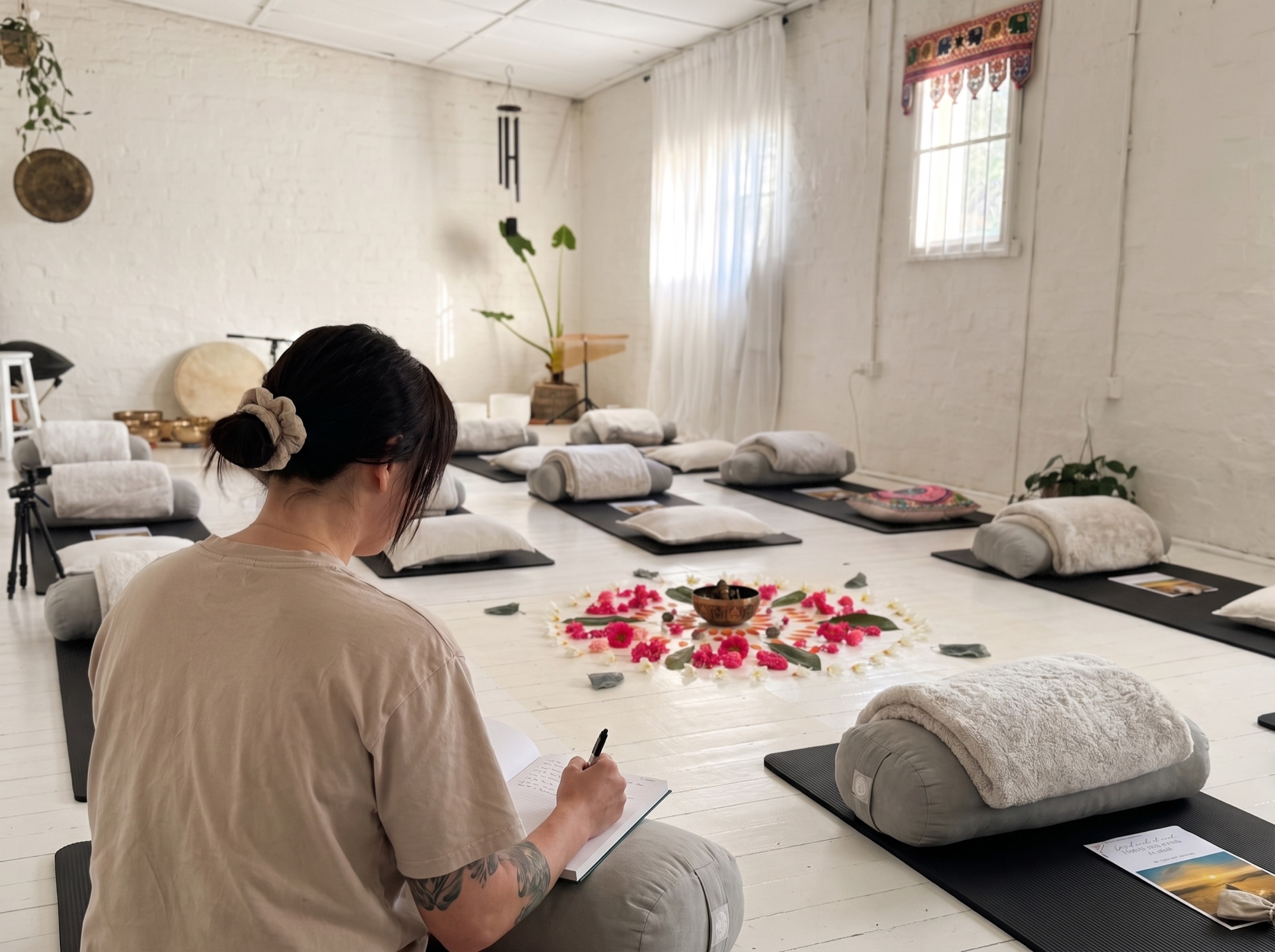
Cacao, a palo santo cleanse, yin, Tibetan bowls resting on the body and a sound bath. Three and a half hours to put down what you do not want to carry into the new season.
See the afternoon